How to Scale Slot Game Production Without Growing Your Internal Team
The online casino industry is growing rapidly, and player demand for fresh content has never been higher. Casino operators expect regular game releases, aggregators continuously onboard new studios, and competition makes it difficult to rely on only a few titles each year. For many slot game developers, the challenge is no longer creating great games—it's producing them consistently and at scale.
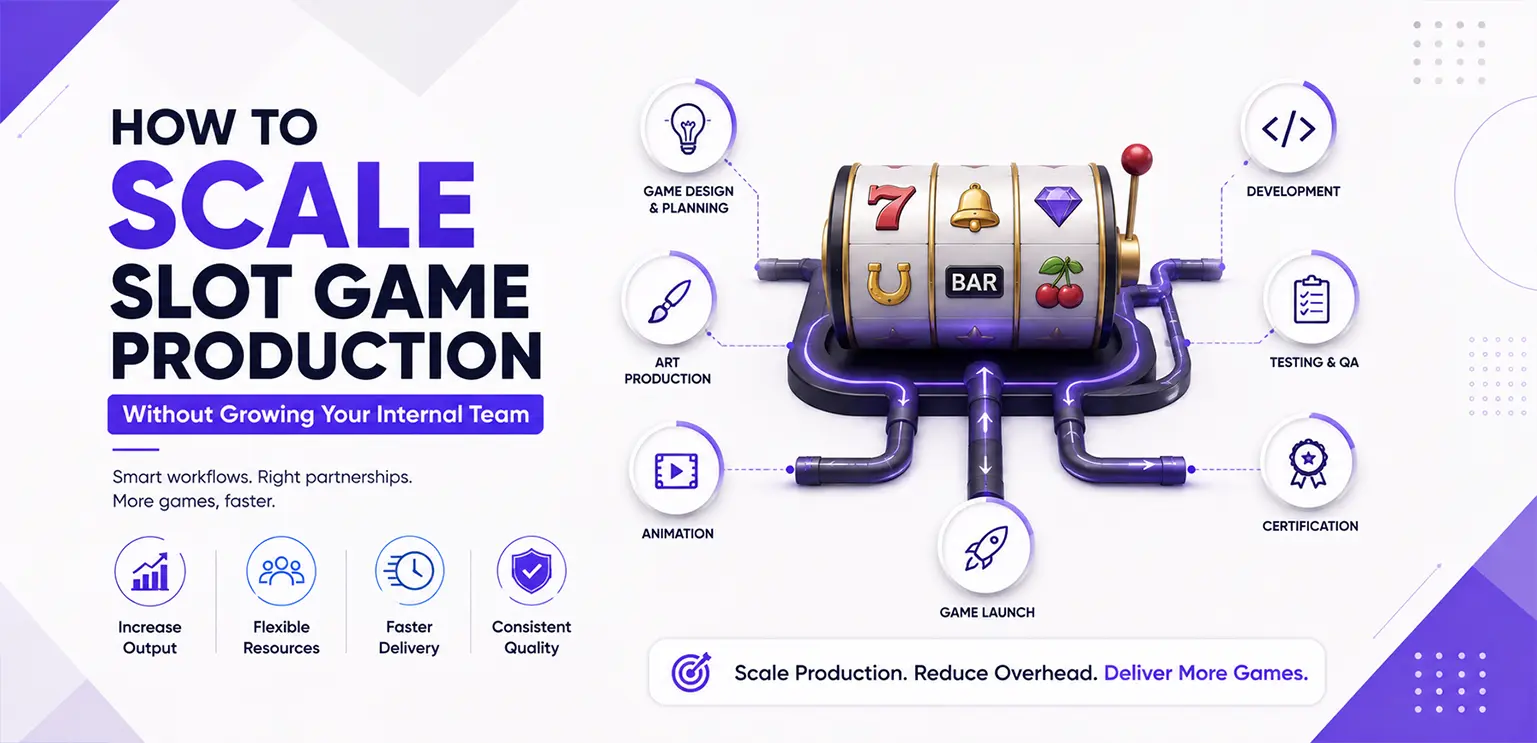
The traditional solution has been to hire more artists, animators, developers, mathematicians, QA engineers, and project managers. While expanding an in-house team can increase production capacity, it also introduces higher operating costs, longer recruitment cycles, additional management responsibilities, and greater business risk.
Today, many successful game studios are taking a different approach. Instead of continuously growing their internal teams, they build scalable production pipelines supported by trusted external partners, standardized workflows, and specialized development resources. This model allows studios to increase output while maintaining quality, meeting deadlines, and controlling costs.
Scaling production without hiring more full-time employees does not mean reducing quality or replacing internal expertise. Instead, it means using resources more efficiently so that internal teams can focus on strategy, creative direction, and core product development while trusted partners handle specialized production tasks.
In this guide, we'll explore how slot game studios can scale production effectively without significantly increasing the internal team, the challenges involved, and the practical strategies used by successful game developers.
Why Scaling Slot Game Production Is Challenging
Building a modern slot game involves far more than designing reels and symbols. Every project requires coordination across multiple disciplines, each with its own technical requirements and own timeline. A typical production cycle may involve:
- Concept artists creating the game's visual identity.
- UI/UX designers developing player interfaces.
- 2D artists producing symbols, backgrounds, and promotional assets.
- Spine or After-Effects animators bringing the artwork to life.
- Developers implementing gameplay mechanics.
- Math designers balancing RTP, volatility, and bonus features.
- QA teams are testing gameplay, compatibility, and performance.
- Certification preparation for regulated markets.
- Integration with casino platforms and aggregators.
As more games enter production, coordinating teams, resources, and timelines becomes increasingly challenging. Without efficient production processes, studios risk missed deadlines, inconsistent quality, and overburdened teams.
What Does "Scaling Without Hiring" Actually Mean?
Scaling production without increasing internal team doesn't mean asking existing employees to work longer hours or handle more responsibilities than they reasonably can. Instead, it means increasing production capacity by improving how work is planned, distributed, and executed.
Studios achieve this by combining internal leadership with external production resources, allowing them to complete more work without dramatically increasing permanent staffing costs. This approach often includes:
- Partnering with specialized outsourcing studios for art, animation, development, or QA.
- Standardizing production workflows so external contributors can integrate quickly.
- Building reusable asset libraries to reduce repetitive work.
- Automating routine production tasks where appropriate.
- Using collaborative project management systems to coordinate distributed teams.
The objective is to create a flexible production model that can expand or contract depending on project demand.
When Should a Studio Consider Scaling?
Not every studio needs to expand immediately. However, there are clear indicators that production capacity is becoming a bottleneck. Some common signs include:
- Project deadlines become harder to meet as workloads increase, leaving teams under constant pressure to keep up with demand.
- New opportunities must be declined. Studios turn down client projects or publishing agreements because they lack available production capacity.
- Key specialists are overloaded. Senior artists, developers, or technical leads become responsible for too many projects simultaneously, increasing the risk of burnout.
- Production quality becomes inconsistent. As workloads increase, maintaining consistent quality across multiple games becomes more challenging.
- Innovation begins to slow because internal teams spend most of their time meeting production deadlines instead of developing new ideas or improving workflows.
Recognizing these warning signs early allows studios to scale in a controlled and sustainable way.
Why Hiring Isn't Always the Best Solution
Hiring more employees is often the first strategy companies consider when production demand increases. While expanding an in-house team can be effective, it is not always the most practical or cost-efficient solution. Recruitment takes time, experienced game development talent can be difficult to find, and onboarding new employees may delay rather than accelerate production in the short term. Hiring also introduces long-term commitments that extend beyond individual projects. Some common challenges include:
- Lengthy recruitment cycles: Finding experienced artists, animators, technical specialists or developers can take weeks or even months.
- Higher operational costs: Salaries, benefits, equipment, software licenses, office space, and ongoing training all contribute to the total cost of permanent employees.
- Variable production demand: Game development workloads often fluctuate. Maintaining a large team during slower periods can reduce operational efficiency.
- Management overhead: Larger teams require additional project management, communication, and coordination.
For studios with changing production schedules, flexible resource planning often provides greater operational efficiency than continuous hiring.
Common Production Bottlenecks
Many production delays are not caused by a lack of creativity. Instead, they result from resource limitations within specific departments. Some of the most common bottlenecks include:
🔹 Game Art Production
Creating high-quality slot symbols, backgrounds, characters, UI elements, and promotional assets requires significant artistic effort. When art production falls behind, the entire project timeline is affected.
🔹 Animation
To create engaging gameplay, modern slot games rely heavily on animation. Limited animation resources can slow production, delaying feature implementation and the final visual polish of the game.
🔹 Technical Development
Gameplay programming, engine integration, backend connectivity, and platform optimization require specialized expertise that may not always be available internally.
🔹 Mathematical Design
Developing balanced RTP models, volatility profiles, and bonus mechanics is highly specialized work. Studios may struggle to develop multiple games simultaneously with limited mathematical resources.
🔹 Quality Assurance
Every slot game must undergo thorough testing before launch to ensure stability, functionality, and quality. As production scales, quality assurance often becomes a major bottleneck unless testing resources grow alongside development capacity.
Building a Flexible Production Model
Rather than viewing every production challenge as a hiring problem, many studios focus on building a production model that adapts to changing workloads. A flexible production model allows studios to balance internal expertise with external support, ensuring core teams remain focused on strategic work while production scales efficiently. This approach typically includes:
- Keeping strategic decisions in-house. Creative direction, game design, product vision, and client communication remain under internal leadership.
- Outsourcing specialized production tasks. Art production, animation, technical development, QA, or asset optimization can be handled by trusted external partners with proven expertise.
- Using standardized production pipelines. Well-defined workflows and consistent processes improve collaboration, minimize confusion, and help external teams become productive more quickly.
- Planning for scalability from the beginning. Production processes are designed to support multiple simultaneous projects rather than a single game at a time.
Studios that build flexible production systems are better equipped to manage changing workloads, accelerate project delivery, and support long-term business growth.
Benefits of Scaling Without Expanding Internal Headcount
A scalable production strategy offers advantages that extend beyond simply producing more games. Some of the most important benefits include:
- Greater production capacity: Studios can work on multiple slot games simultaneously without significantly increasing permanent staffing.
- Faster time-to-market: Parallel production workflows reduce delays and help teams meet publishing schedules more consistently.
- Access to specialized expertise: External partners often bring experience in areas such as slot art, animation, mathematics, certification support, or engine-specific development.
- Better cost control: Studios pay for production resources when needed instead of maintaining a permanently oversized workforce.
- Improved business flexibility: Teams can adapt more easily to changing client requirements, seasonal demand, or new market opportunities.
Ultimately, scaling is not about building the largest team—it's about building the most efficient production system.
Choosing the Right Balance Between In-House and Outsourced Development
One of the biggest mistakes studios make when scaling production is outsourcing without a clear strategy. Successful studios do not outsource everything—they identify which activities create the most value internally and which tasks can be handled efficiently by external specialists.
The goal is to protect your creative vision while increasing production capacity. A practical approach is to keep decision-making and product ownership inside the company while outsourcing execution-heavy tasks that follow well-defined requirements.
🔹 Functions That Typically Stay In-House
These responsibilities usually require close collaboration with stakeholders and have a direct impact on the product's long-term direction.
- Game design and product vision: Internal teams define the gameplay experience, monetization strategy, feature roadmap, and target audience.
- Creative direction: Art style, branding, storytelling, and overall visual consistency are usually controlled by senior internal artists or art directors.
- Project management: Coordinating timelines, reviewing milestones, approving deliverables, and communicating with clients remain core internal responsibilities.
- Mathematical strategy: While external math experts may assist, decisions around RTP targets, volatility, and feature philosophy often remain under internal leadership.
🔹 Functions That Can Be Outsourced
Many production activities follow structured workflows, making them ideal for experienced external partners. These commonly include:
- 2D game art production: Slot symbols, characters, backgrounds, icons, UI elements, and promotional artwork.
- Animation: Spine animation, After Effects animation, VFX implementation, and motion graphics.
- Game development: HTML5, Unity, PixiJS, Cocos Creator, SDK implementation, backend integration, and platform-specific optimization.
- Quality Assurance: Functional testing, compatibility testing, performance testing, regression testing, and certification support.
- Audio Production: Create music, sound effects, voice-overs, and other audio assets that enhance gameplay and deliver a more immersive player experience.
By separating strategic work from production work, studios can expand output while maintaining creative control.
Build a Repeatable Production Pipeline
When every project follows a repeatable workflow, scaling becomes much easier.
Without standardized production processes, every new slot game requires teams to repeat the same setup work. Time is spent recreating documentation, establishing workflows, and resolving familiar production challenges instead of focusing on development.
Instead, successful studios develop production pipelines that can be reused across multiple projects. A typical slot game production pipeline may include:
- Concept and market research.
- Game Design Document (GDD) preparation.
- Art direction and style guide approval.
- Asset production.
- Animation.
- Game development and implementation.
- Mathematical balancing.
- Internal QA.
- Simulation testing.
- Certification preparation.
- Operator integration.
- Commercial launch.
Following the same structured process helps teams deliver consistent results while reducing unnecessary delays.
Standardize Documentation
Clear documentation is the foundation of an efficient production pipeline. It helps teams follow consistent processes, accelerates onboarding, reduces confusion, and ensures everyone is working toward the same project objectives. Useful documents include:
- Game Design Documents (GDDs): Define mechanics, bonus features, win conditions, and gameplay rules.
- Art Style Guides: Specify colors, UI patterns, animation style, typography, lighting, and visual references.
- Technical Specifications: Document engine requirements, APIs, SDKs, naming conventions, and file structures.
- Production Checklists: Provide a structured way to verify that required assets, approvals, and project milestones are completed before the next stage of development begins.
Well-maintained documentation allows external contributors to become productive much faster.
Build Reusable Asset Libraries
Creating every asset from scratch for each project can slow production and increase development costs. Reusable asset libraries help studios streamline workflows by adapting proven assets across multiple games. Examples include:
- UI components.
- Buttons and icons.
- Particle effects.
- Animation templates.
- Background elements.
- Sound effects.
- Technical frameworks.
- Development tools.
Reusable assets do not reduce creativity. Instead, they eliminate repetitive work so teams can focus on creating unique gameplay experiences.
Improve Collaboration Across Distributed Teams
Modern game development often involves teams working from different cities—or even different countries. Without structured communication, distributed production can quickly become difficult to manage. Some best practices include:
- Establish clear ownership: Every task should have a designated owner responsible for its completion.
- Define review milestones: Regular feedback cycles help identify issues before they become expensive to fix.
- Maintain centralized documentation: Teams should always work from the latest approved files and specifications.
- Use consistent communication channels: Avoid spreading project information across multiple disconnected platforms.
Strong collaboration reduces production delays and improves overall project visibility.
Use the Right Production Tools
Technology plays a significant role in helping studios scale efficiently. The right tools improve coordination, reduce manual work, and make production progress easier to track. Commonly used tools include:
- Project management platforms: Track tasks, milestones, priorities, and deadlines across multiple teams.
- Version control systems: Manage source code and collaborative development while reducing conflicts.
- Digital asset management: Organize artwork, animations, audio files, and production resources.
- Communication platforms: Support daily collaboration between internal and external contributors.
- Documentation tools: Keep production guidelines, technical specifications, and workflows accessible to everyone.
The tools themselves are not the solution—the value comes from using them consistently within a structured production process.
Maintain Quality While Scaling
One of the biggest concerns when increasing production capacity is maintaining consistent quality across multiple projects. Quality should not depend solely on individual talent. Instead, it should be supported by repeatable review processes and clear production standards. Effective quality management includes:
- Establishing approval checkpoints: Assets, animations, and gameplay systems should be reviewed before progressing to the next production stage.
- Using standardized quality guidelines: Every contributor should understand the expected level of detail, technical requirements, and artistic style.
- Conduct regular reviews: Reviewing work at key production milestones helps identify issues early, maintain quality standards, and reduce the need for extensive revisions later in development.
- Testing continuously: QA should begin during development rather than waiting until the end of production.
Scaling successfully means producing more games without lowering the quality players and operators expect.
Common Mistakes That Prevent Studios from Scaling
Even experienced development teams encounter challenges when expanding production. Understanding these common mistakes can help studios avoid costly delays.
🔹 Hiring Too Quickly
Expanding headcount before improving production processes often increases complexity without significantly improving output. A better approach is to optimize workflows first, then hire where long-term demand justifies it.
🔹 Outsourcing Without Clear Documentation
The success of outsourced development relies on clear direction. Comprehensive documentation, including project briefs, style guides, and technical requirements, enables external teams to produce consistent, high-quality deliverables.
🔹 Micromanaging Every Task
Internal teams should focus on strategic oversight rather than reviewing every minor production decision. Trust and structured review processes help external partners work more efficiently.
🔹 Ignoring Knowledge Sharing
Important production knowledge should not remain with a single individual. Documenting workflows makes the organization more resilient and easier to scale.
🔹 Prioritizing Speed Over Quality
Releasing more games is valuable only if they meet player expectations and regulatory standards. Maintaining quality should remain a core objective throughout production.
Best Practices for Sustainable Growth
Successful studios don't rely on individual effort alone—they build production systems that can be repeated, refined, and scaled over time. Some best practices include:
- Build repeatable production workflows. Well-defined processes reduce dependency on individual team members, improve consistency across projects, and make it easier to scale production as demand grows.
- Build long-term partnerships with trusted external teams. Working with reliable development partners who understand your workflows, quality standards, and expectations often leads to better collaboration, faster delivery, and more consistent results than frequently changing vendors.
- Use production metrics to guide improvements. Reviewing data such as milestone completion rates, delivery speed, and revision cycles helps teams refine workflows and increase production efficiency.
- Invest in documentation and automation. Reducing repetitive work allows teams to focus on higher-value creative and technical tasks.
- Scale gradually. Expanding production in controlled stages reduces operational risk and makes it easier to maintain consistent quality.
Studios that focus on sustainable growth are often better prepared to respond to new publishing opportunities without disrupting existing projects.
How AAA Studios Scale Game Production
Large game studios rarely rely only on their internal teams to produce every asset, animation, or technical feature. Instead, they build structured production ecosystems where internal departments work alongside trusted external partners. This approach allows them to develop multiple projects simultaneously while maintaining consistent quality and predictable delivery schedules.
Rather than outsourcing because of limited resources, AAA studios often outsource because it improves efficiency and gives internal teams more time to focus on creative leadership and product innovation. Common practices include:
- Building long-term partnerships: Instead of changing vendors for every project, experienced studios work with reliable partners who understand their production standards and pipelines.
- Using standardized workflows: Every project follows documented processes, making it easier for internal and external teams to collaborate efficiently.
- Scaling resources when needed: Teams expand production capacity during busy periods and reduce external support after project completion without affecting permanent staffing levels.
- Maintaining creative oversight: Internal teams guide the creative vision by reviewing concepts, key milestones, and final deliverables to ensure every game aligns with the studio's quality standards and design goals.
This production model has become widely adopted across the gaming industry because it enables studios to scale efficiently while maintaining creative consistency and production quality.
Why Leading Studios Use Outsourcing to Scale Production
Many people view outsourcing primarily as a way to reduce operational costs. While cost efficiency is a valuable advantage, leading game studios use outsourcing to expand production capacity, access specialized expertise, and support long-term business growth. Partnering with experienced external teams enables studios to:
- Release more games each year: Additional production capacity allows multiple projects to move forward in parallel without overwhelming internal teams.
- Enter new markets faster: Specialized partners with expertise in compliance, certification, localization, or platform integration can help accelerate expansion into regulated markets.
- Access niche expertise: Studios can quickly bring in specialists for areas such as slot mathematics, Spine animation, backend development, SDK integration, or performance optimization without long recruitment cycles.
- Reduce operational risk: Instead of permanently increasing payroll, studios can scale resources based on project demand, making it easier to adapt to changing business conditions.
- Keep internal teams focused on innovation: By delegating production-intensive tasks, senior designers, developers, and artists can spend more time improving gameplay, exploring new ideas, and strengthening the studio's competitive advantage.
Viewed this way, outsourcing becomes a strategic tool for growth rather than a short-term operational decision.
Measuring Whether Your Scaling Strategy Is Working
Scaling production should lead to measurable improvements, not simply more activity. Studios should regularly review key performance indicators (KPIs) to determine whether their production model is becoming more efficient. Useful metrics include:
- Games delivered per year: A higher number of completed projects without compromising quality indicates increased production capacity.
- Average production timeline: Monitoring how long projects take from concept to delivery helps identify workflow improvements.
- Revision rates: Fewer revisions often indicate clearer documentation and stronger collaboration.
- On-time milestone completion: Consistently meeting production milestones reflects a well-organized pipeline.
- Quality assurance results: Lower defect rates before launch demonstrate that quality is being maintained while scaling.
- Client satisfaction and repeat business: Long-term partnerships often reflect reliable delivery and consistent production quality.
Tracking these metrics provides objective evidence that production improvements are delivering real business value.
The Future of Scalable Slot Game Production
Slot game development continues to evolve as new technologies, production workflows, and development tools reshape the industry. As studios aim to deliver more games with greater efficiency, scalable production models are becoming increasingly important.
🔹 AI-Assisted Production
Artificial intelligence is increasingly supporting repetitive production tasks such as concept exploration, documentation assistance, asset organization, localization support, and quality analysis. Rather than replacing creative teams, AI helps reduce manual work and allows specialists to focus on high-value design and development.
🔹 Modular Game Development
Many studios now build reusable systems that can be shared across multiple projects. Examples include:
- Bonus feature frameworks.
- UI component libraries.
- Backend modules.
- Animation templates.
- SDK integration layers.
- Testing frameworks.
Modular development reduces production time while maintaining consistency across games.
🔹 Cloud-Based Collaboration
Cloud-based production environments allow distributed teams to collaborate more efficiently regardless of location. Benefits include:
- Faster asset sharing.
- Real-time documentation updates.
- Simplified version management.
- Improved project visibility.
These workflows are becoming increasingly important as game development becomes more globally distributed.
🔹 Data-Driven Production Planning
Studios are relying more heavily on production analytics to improve planning and resource allocation. By analyzing previous projects, teams can estimate timelines more accurately, identify recurring bottlenecks, and make better decisions about staffing and outsourcing.
How Gamix Labs Helps Studios Scale Production
At Gamix Labs, scalability is built around the idea of becoming an extension of a client's development team rather than simply delivering outsourced tasks. The focus is on helping studios increase production capacity while maintaining creative consistency, technical quality, and predictable delivery schedules. Key areas of support include:
- Slot game art production: High-quality symbols, backgrounds, UI assets, promotional artwork, and complete visual themes created to match established art directions.
- Animation services: Spine animation, After Effects animation, VFX, and feature animations optimized for modern slot games.
- Game development: HTML5, Cocos Creator, Unity, PixiJS, and engine-ready implementation with an emphasis on performance and scalability.
- Technical production support: SDK integration, optimization, backend collaboration, and platform-ready development workflows.
- Production flexibility: Teams can scale resources according to project requirements, allowing studios to manage changing workloads without expanding permanent headcount.
By combining specialized expertise with structured production processes, Gamix Labs helps publishers, operators, and development studios deliver more games while maintaining high production standards.
Conclusion
Scaling slot game production isn't simply about expanding your workforce. As projects become more complex and release schedules become more demanding, studios need efficient production systems that can adapt to changing workloads without compromising quality.
Studios that invest in structured pipelines, clear documentation, and reliable external partnerships are better equipped to deliver high-quality slot games, meet deadlines consistently, and support sustainable business growth. When integrated into a well-defined production strategy, outsourcing complements rather than replaces an in-house team. It gives studios access to specialized expertise, expands production capacity, and enables internal teams to stay focused on high-value creative and technical work.
For casino operators and publishers, choosing development partners with scalable production capabilities can lead to faster releases, more consistent quality, and greater confidence when planning future content pipelines. As the iGaming industry continues to expand, studios that invest in scalable production systems today will be better positioned to deliver high-quality slot games consistently, respond quickly to market opportunities, and maintain a competitive advantage.
FAQs
What does scaling slot game production mean?
Scaling slot game production means increasing the number of games or production capacity without reducing quality, missing deadlines, or significantly increasing operational complexity.
Can a studio scale without hiring more employees?
Yes. Many studios increase production by improving workflows, automating repetitive tasks, using reusable production systems, and partnering with experienced external development teams.
What work is commonly outsourced in slot game development?
Studios frequently outsource game art, animation, HTML5 development, Cocos Creator development, quality assurance, audio production, technical art, and platform integration while keeping creative direction and product strategy in-house.
Does outsourcing reduce game quality?
Not when managed effectively. Clear documentation, structured review processes, and collaboration with experienced partners help maintain consistent quality while increasing production capacity.
Why do AAA game studios use external development partners?
AAA studios use external partners to access specialized expertise, support multiple projects simultaneously, accelerate production, and allow internal teams to focus on creative leadership and innovation.
How can studios maintain quality while scaling?
Maintaining standardized production pipelines, documenting workflows, conducting regular reviews, and integrating continuous quality assurance throughout development all help ensure consistent quality as production grows.