External Development in Live Service Games: Scaling Content and Operations Efficiently
For live service games, launch day is not the finish line but the first stage of long-term operations, content updates, and player engagement. For modern live service titles, launch day is often just the beginning of a much longer journey.
Today's players expect continuous updates, seasonal events, new content, balance improvements, technical enhancements, and ongoing engagement initiatives. Whether it's a mobile game, multiplayer title, social casino game, or online platform, maintaining player interest requires a constant stream of fresh content and operational support.
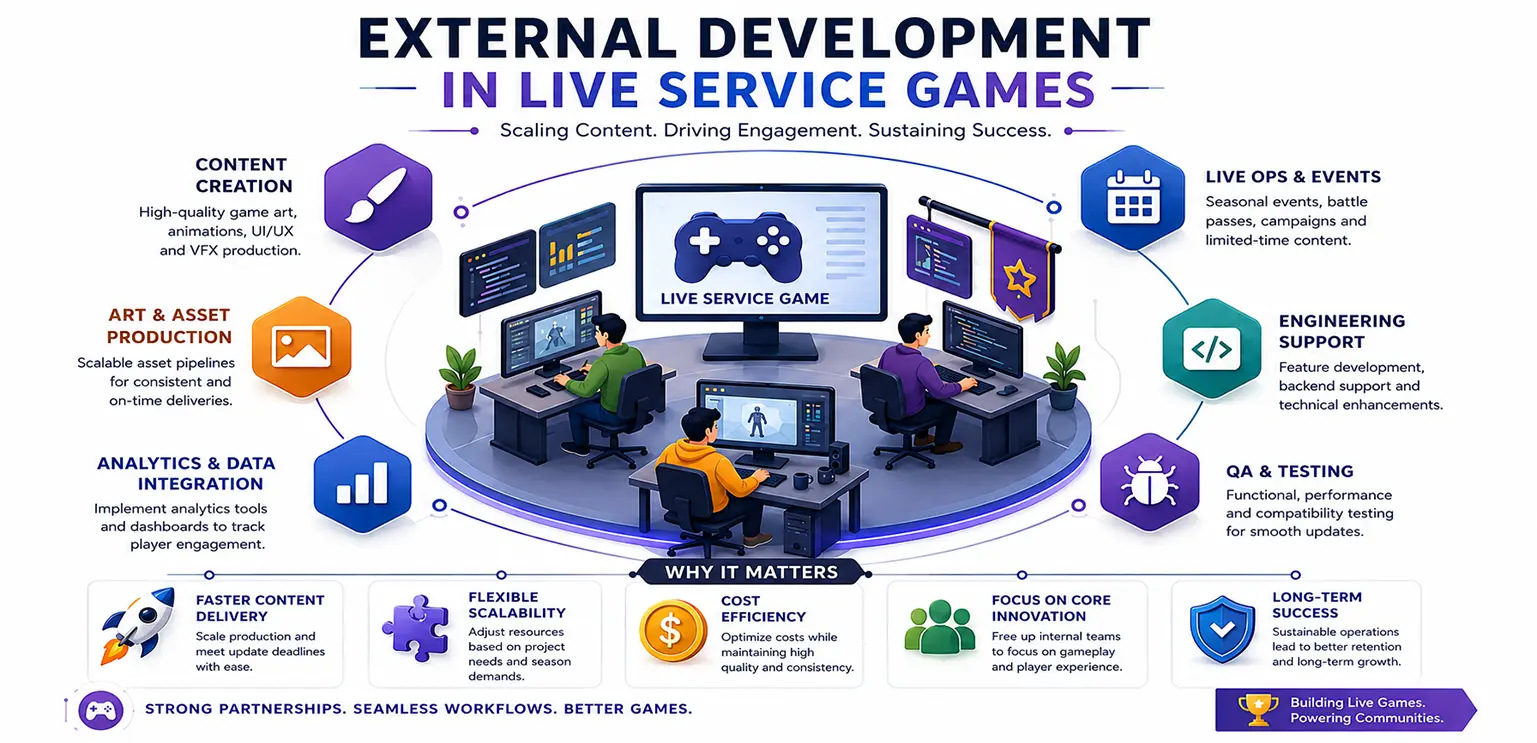
This growing demand has fundamentally changed how studios approach production.
Rather than relying exclusively on internal teams, many publishers now integrate external development partners into their long-term Live Ops strategies. These partnerships help studios scale production, accelerate content delivery, and maintain consistent update schedules without significantly increasing permanent headcount.
As live service models continue to dominate the industry, external development has evolved from supplemental support into a core operational strategy.
Understanding External Development in Live Service Environments
External development refers to the use of specialized third-party teams that contribute to various aspects of game production and ongoing operations. Unlike traditional project-based outsourcing, live service partnerships often involve continuous collaboration throughout a game's lifecycle. External teams may support:
- Content production
- Game art creation
- UI/UX development
- Animation
- Live Ops events
- Engineering support
- Quality assurance
- Performance optimization
Often, these teams function as extensions of the studio's internal departments rather than separate vendors. The objective is not simply reducing workload but creating scalable production systems capable of supporting long-term game growth.
Why Live Service Games Create Unique Production Challenges
Traditional game development follows a relatively predictable production cycle. Teams build a product, launch it, and then move into maintenance or expansion phases. Live service games operate differently.
Content development never truly ends. Studios must continuously produce updates while simultaneously monitoring player behavior, balancing systems, fixing issues, and planning future releases. This creates several operational challenges:
- Constant content demand
- Tight update schedules
- Increased asset production requirements
- Multi-platform support obligations
- Growing Live Ops complexity
As content demands continue to grow, many internal teams find it increasingly difficult to maintain production speed without additional support. External development helps address this scalability challenge.
The Growing Role of External Teams in Content Production
Content creation represents one of the largest ongoing demands in live service development. Seasonal events, limited-time campaigns, cosmetic updates, new features, and promotional content require significant production resources. External partners frequently contribute to:
- Environment assets
- Character art
- UI components
- Promotional creatives
- Event-specific content
- Animation packages
By offloading production-heavy tasks, studios can maintain aggressive content schedules while allowing internal teams to focus on strategic development priorities. This approach to scalable outsourcing pipelines has become increasingly common across both mobile and casino gaming sectors, where content frequency directly impacts player retention.
Supporting Live Ops Through External Development
Live Ops has become one of the most important components of successful live service games. Effective Live Ops strategies require regular updates that keep players engaged over extended periods. External development teams often assist with:
- Seasonal event implementation
- Content refreshes
- Feature updates
- Community-driven content initiatives
- Limited-time game modes
Because these activities operate on recurring schedules, scalable production capacity becomes essential. Studios that can rapidly execute Live Ops initiatives often maintain stronger engagement metrics than competitors with slower update cycles.
How External Development Improves Production Scalability
One of the primary advantages of external development is production flexibility. Internal hiring can be expensive, time-consuming, and difficult to scale quickly. Production demands, however, rarely remain consistent throughout a live service game's lifecycle. Workload often increases during:
- Major content releases
- Seasonal campaigns
- Feature expansions
- Marketing initiatives
- Platform launches
External teams provide elastic production capacity that can expand or contract based on project requirements. This flexibility allows studios to adapt more efficiently to changing operational demands.
Engineering Support Beyond Content Creation
External development is often associated with art production, but engineering support has become increasingly valuable as live service systems grow more complex. External engineering teams may assist with:
- Backend development
- Feature implementation
- Platform integrations
- SDK support
- Analytics systems
- Performance optimization
This technical support enables internal developers to focus on core gameplay innovation while maintaining ongoing operational stability. For large-scale live service ecosystems, engineering partnerships can significantly improve development velocity.
Quality Assurance and Continuous Testing
Frequent updates introduce a constant risk of bugs, performance issues, and compatibility problems. Unlike traditional games, live service titles cannot rely solely on pre-launch testing. Every update requires validation across multiple devices, platforms, and user scenarios. External QA teams often support:
- Regression testing
- Compatibility testing
- Feature validation
- Localization verification
- Performance bench-marking
Continuous testing helps reduce deployment risks and improves overall player experience.
Maintaining Consistency Across Distributed Teams
While external development offers significant advantages, maintaining consistency remains a critical challenge. Without proper oversight, studios may encounter:
- Quality inconsistencies
- Communication delays
- Production bottlenecks
- Revision overload
Successful live service studios address these challenges through structured production systems. This typically includes:
- Detailed documentation
- Shared style guides
- Standardized workflows
- Regular review cycles
- Clear approval processes
The strongest partnerships operate within integrated pipelines built around distributed teams rather than isolated production environments.
Strategic Benefits Beyond Cost Efficiency
While external development can improve cost efficiency, its greatest value lies in enhancing production scalability, flexibility, and long-term operational performance. When production-heavy tasks are delegated effectively, internal teams gain additional capacity for:
- Gameplay innovation
- Feature experimentation
- System design improvements
- Long-term planning
- Technical modernization
This shift allows studios to focus on activities that directly influence product differentiation and competitive advantage. Often, the value of strategic focus exceeds the financial benefits of outsourcing alone.
How Casino and Social Gaming Studios Utilize External Development
Casino and social gaming products often rely heavily on recurring content updates. New themes, seasonal campaigns, visual refreshes, and promotional assets must be produced consistently to maintain engagement. As a result, many operators integrate external partners directly into their production pipelines. External teams frequently contribute to:
- Slot game art
- UI systems
- Promotional content
- Animation packages
- Event-specific assets
Because content velocity is closely tied to player retention, scalable production support from experienced art teams becomes a significant competitive advantage.
Choosing the Right External Development Partner
Not all development partners provide the same level of value. Studios should evaluate potential partners based on:
- Industry experience
- Technical capabilities
- Production scalability
- Communication processes
- Pipeline compatibility
- Quality assurance standards
Price should not be the primary deciding factor. Long-term success depends far more on reliability, consistency, and operational alignment than on short-term cost reductions.
Studios such as Gamix Labs often support live service projects through integrated production models that align closely with internal workflows, helping publishers scale content creation while maintaining quality standards and delivery consistency.
Future Trends in External Development for Live Service Games
As live service ecosystems continue expanding, external development partnerships are becoming increasingly sophisticated. Future trends are expected to include:
- AI-assisted asset production
- Real-time collaborative pipelines
- Live analytics integration
- Automated content workflows
- Technical art specialization
- Live Ops optimization support
External teams will likely play a larger role not only in content production but also in strategic operational planning. The distinction between internal and external development teams may continue to blur as collaboration models evolve.
Strategic Takeaways for Publishers and Studios
Live service games require continuous production, operational agility, and scalable content pipelines. External development enables studios to:
- Increase production capacity
- Accelerate content delivery
- Support Live Ops initiatives
- Improve operational flexibility
- Reduce internal resource constraints
When integrated effectively, external teams become strategic partners rather than temporary production vendors. This approach helps studios maintain player engagement while adapting to evolving market demands.
Conclusion
The rise of live service gaming has fundamentally changed how development teams operate. Continuous updates, seasonal content, and evolving player expectations require a level of production scalability that many internal teams cannot sustain alone. External development provides the flexibility, expertise, and capacity needed to support these ongoing demands.
From content creation and engineering support to QA and Live Ops execution, external partners have become an essential part of modern live service ecosystems. For studios seeking long-term growth and operational efficiency, external development is no longer simply an outsourcing decision—it is a critical component of sustainable live service strategy.
FAQs
What is external development in live service games?
It involves third-party teams supporting ongoing content production, Live Ops, engineering, QA, and other development activities.
Why do live service games rely on external teams?
Because continuous updates create production demands that are difficult to sustain using internal teams alone.
What areas are commonly outsourced?
Game art, animation, UI/UX, engineering support, QA, promotional content, and Live Ops implementation.
Does external development improve scalability?
Yes. It allows studios to increase production capacity without significantly expanding permanent headcount.
What is the biggest challenge in external development?
Maintaining quality consistency and workflow alignment between internal and external teams.
How do successful studios manage external partnerships?
Through clear documentation, structured review processes, shared production standards, and ongoing communication.