The Evolution of Modern Game Development: From Small Teams to AI-Powered Production
Game development has never evolved as rapidly as it has over the last two decades. What once involved a few passionate developers working on relatively simple projects has transformed into one of the world's most sophisticated creative and technology-driven industries. Today's games are built using advanced engines, AI-powered tools, cloud collaboration platforms, automated pipelines, and specialized production teams working together across multiple countries.
This transformation hasn't happened simply because technology became more powerful. Player expectations have changed just as quickly. Modern gamers expect cinematic visuals, responsive gameplay, frequent content updates, seamless multiplayer experiences, and flawless performance across mobile devices, PCs, consoles, and even web browsers. Delivering these experiences requires much more than talented programmers or artists—it demands structured production, efficient collaboration, and scalable development processes.
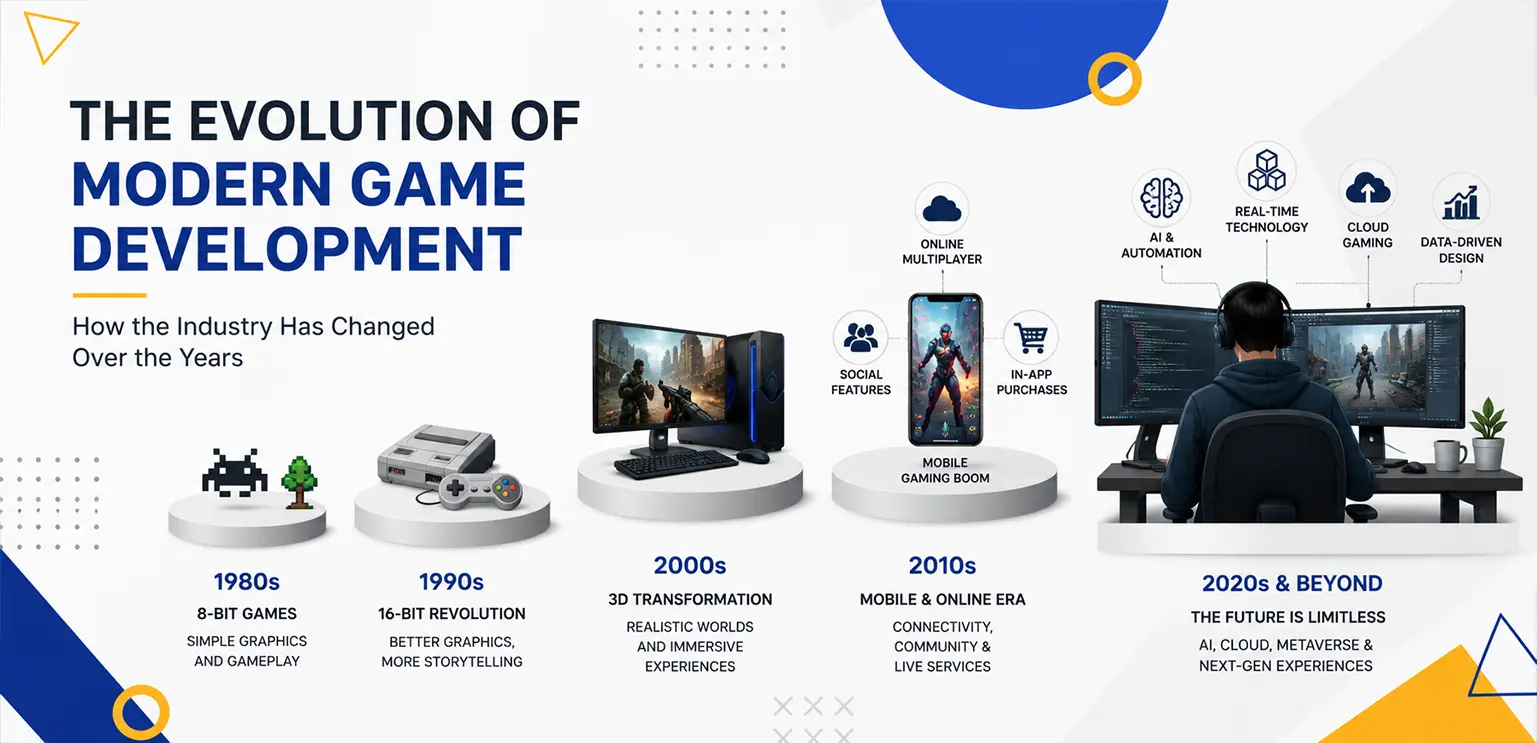
Modern game development is no longer only about writing code or creating impressive visuals. It combines software engineering, technical art, UI/UX design, quality assurance, production management, analytics, artificial intelligence, and LiveOps into one continuous workflow. Every department contributes to the final experience, making collaboration one of the industry's biggest strengths.
Whether you're building an indie title, a multiplayer game, or a casino platform, understanding how game development has evolved provides valuable insight into the workflows, technologies, and production strategies that define successful studios today.
From Passion Projects to Global Development Teams
In the early days of gaming, development teams were incredibly small. A single developer often handled programming, level design, artwork, sound effects, and testing. Hardware limitations naturally kept projects manageable, allowing studios to release games within relatively short production cycles.
Despite these constraints, many classic games remain influential because developers focused on creativity and gameplay rather than visual complexity. Limited technology encouraged innovation, and studios learned to deliver memorable experiences using minimal resources.
Today, game development looks completely different.
AAA productions frequently involve hundreds of professionals working across multiple disciplines. Even mid-sized studios collaborate with external partners to meet growing production demands. Artists, programmers, designers, producers, technical artists, QA engineers, DevOps specialists, and outsourcing teams all contribute simultaneously throughout development.
This collaborative approach enables studios to build larger worlds, richer gameplay systems, and higher-quality player experiences than ever before.
How Modern Game Engines Revolutionized Game Development
One of the biggest milestones in modern game development has been the evolution of professional game engines. In the past, many studios built proprietary engines before they could even begin gameplay development. Today, engines such as Unity, Unreal Engine, Cocos Creator, and PixiJS provide complete ecosystems that include rendering, physics, animation, scripting, UI tools, debugging, and cross-platform deployment.
These engines allow developers to focus more on gameplay, art, and player experience rather than rebuilding core technology. They also improve collaboration between programmers, artists, and designers by providing shared tools, integrated asset management, visual scripting, and built-in optimization features. As a result, studios can shorten development cycles while maintaining consistent quality across multiple platforms.
Why Production Pipelines Have Become the Backbone of Modern Game Development
As games became larger and more complex, studios realized that talent alone was no longer enough. Without structured workflows, projects quickly faced inconsistent assets, duplicated work, communication gaps, and costly delays. This led to the adoption of modern production pipelines that organize every stage of development—from concept art and programming to testing, optimization, deployment, and LiveOps.
A structured pipeline allows multiple departments to work simultaneously. While artists create assets, technical artists optimize them, programmers implement gameplay systems, and QA engineers test completed milestones. Because every team follows the same documentation, review process, and production standards, work moves efficiently without unnecessary bottlenecks.
Beyond improving collaboration, mature production pipelines reduce production costs, accelerate development, maintain consistent quality, and make it easier to scale teams or integrate outsourcing partners.
Game Art Has Become a Technical Discipline
Modern game art extends far beyond creating beautiful illustrations. Today's artists must understand how their work affects gameplay performance, memory consumption, animation, engine integration, and production efficiency.
Every asset—from characters and environments to icons and interface elements—must balance artistic quality with technical requirements.
For example, an environment artist no longer focuses only on visual appeal. They also consider polygon budgets, texture resolution, shader compatibility, lighting behavior, and optimization for multiple platforms. Likewise, UI designers create interfaces that remain readable across different screen sizes while supporting responsive layouts and accessibility standards.
This close relationship between creativity and engineering has transformed game art into one of the most collaborative disciplines within modern game development.
Studios increasingly rely on technical artists to bridge the gap between visual design and engine implementation, ensuring assets remain visually impressive without compromising performance.
Cross-Platform Development Has Become an Industry Standard
Modern players expect to enjoy their favorite games wherever they choose to play. Whether using smartphones, tablets, gaming PCs, consoles, or web browsers, they expect a consistent experience across every platform. Meeting these expectations requires much more planning than simply exporting a game to different devices.
Developers now build flexible systems that automatically adapt to varying screen sizes, hardware capabilities, operating systems, and input methods. User interfaces must remain intuitive, assets must scale correctly, and gameplay systems must perform reliably regardless of platform.
Studios that prioritize cross-platform compatibility early in production avoid costly redevelopment later while significantly expanding their potential audience. Cross-platform development has become less of a competitive advantage and more of an industry expectation.
LiveOps Has Changed the Definition of "Finished"
Years ago, launching a game usually marked the end of development. Once the product reached players, major changes were relatively uncommon. Today, launch day is simply the beginning.
Modern studios increasingly treat games as long-term services that evolve continuously through Live Operations (LiveOps). Seasonal events, new content, gameplay balancing, technical improvements, community features, and limited-time experiences keep players engaged long after release. This evolution has fundamentally changed how games are designed.
Rather than building static experiences, developers now create scalable systems capable of supporting years of ongoing updates. Production teams plan future content long before launch, ensuring new features can be introduced without disrupting existing gameplay. As a result, successful game development now extends far beyond release day.
AI and Emerging Technologies Are Reshaping Game Development
Artificial Intelligence has become one of the most influential technologies in modern game development. Rather than replacing developers, AI accelerates repetitive tasks such as concept exploration, rapid prototyping, automated testing, production planning, and player behavior analysis. This allows artists, designers, and programmers to spend more time on creativity and innovation.
Alongside AI, other technologies are also transforming production. Cloud collaboration platforms connect globally distributed teams, procedural content generation reduces manual work, real-time rendering improves visual quality, and machine learning enables more personalized player experiences. Together, these technologies are helping studios build games faster while maintaining higher production standards.
Outsourcing Has Become a Strategic Advantage
As games continue to grow in scope and complexity, even experienced studios face challenges in delivering high-quality content within tight production schedules. Hiring large in-house teams for every discipline is often expensive, time-consuming, and difficult to scale. This is why outsourcing has evolved from a temporary solution into a long-term production strategy adopted by studios of every size.
Rather than replacing internal teams, outsourcing extends their capabilities. External partners contribute specialized expertise while allowing in-house developers to remain focused on gameplay innovation, core systems, and creative direction. Studios commonly outsource production tasks such as:
- Game art and asset creation, including characters, environments, props, UI elements, and promotional artwork that require dedicated artistic expertise.
- Animation and visual effects, allowing internal teams to focus on gameplay systems while external specialists deliver polished animations and high-quality VFX.
- Technical art and engine integration, ensuring assets are optimized, production-ready, and compatible with the chosen game engine.
- Quality assurance and testing, where external QA teams perform functional, compatibility, regression, and performance testing across multiple devices.
- LiveOps content production, enabling studios to release seasonal events, new levels, cosmetic items, and promotional content without slowing core development.
For example, a studio developing a multiplayer mobile game may outsource environment art and UI production while its internal developers focus on networking, gameplay balancing, and backend services. This parallel workflow significantly reduces production time without sacrificing quality.
Production partners such as Gamix Labs work as extensions of internal development teams by delivering engine-ready assets, technical support, animation, UI/UX, and production services that integrate directly into established workflows.
When managed effectively, outsourcing improves scalability, reduces hiring costs, shortens development timelines, and provides access to specialized talent that may not exist within an internal team.
Data-Driven Development Is Creating Better Player Experiences
Modern game development is no longer guided solely by creative intuition. While creativity remains essential, successful studios increasingly rely on analytics to understand how players actually interact with their games.
Instead of waiting for community feedback after launch, development teams monitor player behavior throughout production and LiveOps. These insights help identify which features players enjoy, where they struggle, and what improvements should be prioritized in future updates. Common production metrics include:
- Player retention, which indicates how effectively a game encourages users to return over time.
- Session duration, helping developers understand whether gameplay loops remain engaging without becoming repetitive.
- Feature engagement, revealing which mechanics, events, or progression systems receive the most attention.
- User interface interactions, allowing designers to simplify navigation and improve accessibility based on real player behavior.
These insights enable studios to make informed decisions rather than relying on assumptions. As a result, updates become more meaningful, balancing improves faster, and overall player satisfaction increases.
Why Specialized Roles Are Essential in Modern Studios
The complexity of modern games has created an increasing demand for specialized professionals. While earlier development teams often relied on generalists, today's productions require experts dedicated to specific disciplines. Technical artists optimize assets for engine performance, pipeline engineers automate production workflows, DevOps specialists maintain deployment infrastructure, LiveOps managers oversee post-launch content, and data analysts transform player behavior into actionable insights.
Each role contributes to a different stage of development, but together they create a production environment that is faster, more organized, and significantly more scalable. This specialization also improves collaboration. Instead of one person attempting to solve every challenge, experienced professionals focus on their area of expertise while working within a shared production pipeline.
Modern Game Development Also Brings New Challenges
Although technology has made development faster and more accessible, it has also introduced new challenges that studios must manage carefully. Larger teams, more ambitious projects, and increasing player expectations have made production significantly more demanding than it was a decade ago. Some of the biggest challenges modern studios face include:
- Rising production costs, as high-quality graphics, advanced gameplay systems, and long-term LiveOps require larger budgets and specialized talent.
- Longer development cycles, with many projects taking several years to complete due to their scale and complexity.
- Growing player expectations, where audiences expect regular updates, polished experiences, and consistent performance across every platform.
- Technical complexity, as games integrate multiplayer systems, cloud services, AI features, and cross-platform compatibility.
- Security and compliance requirements, particularly for online and regulated gaming platforms where data protection and platform certification are essential.
These challenges highlight why structured production pipelines, experienced teams, and efficient collaboration have become essential rather than optional.
What the Next Decade of Game Development Looks Like
The future of game development will be defined by studios that successfully combine technological innovation with efficient production practices. New tools will continue to simplify repetitive work, but creativity, strategic planning, and player-focused design will remain the industry's greatest competitive advantages. Future development is likely to focus on:
- Greater use of AI-assisted production without reducing the importance of human creativity.
- Faster cross-platform development supported by increasingly powerful game engines.
- Smarter production pipelines that automate repetitive tasks while improving collaboration.
- More flexible outsourcing partnerships that allow studios to scale according to project requirements.
- Stronger LiveOps strategies that extend the lifespan of games through continuous updates and community engagement.
Studios that invest in both technology and production discipline will be better positioned to adapt to future market demands.
Key Takeaways
Modern game development has evolved far beyond programming and visual design. Today's successful projects combine creativity with structured production systems that support collaboration, scalability, and continuous improvement. The most important lessons from this evolution include:
- Invest in structured production pipelines to reduce delays, improve collaboration, and maintain consistent quality throughout development.
- Leverage modern game engines to accelerate production while enabling cross-platform deployment and advanced technical capabilities.
- Treat optimization as an ongoing process rather than a final production phase to improve performance across all target platforms.
- Use Artificial Intelligence as a productivity tool, allowing experienced professionals to focus on creativity and complex problem-solving.
- Build long-term outsourcing partnerships that expand production capacity without sacrificing quality or creative control.
- Make data-informed decisions by combining analytics with player feedback to continuously improve gameplay and long-term engagement.
Studios that embrace these principles are far better equipped to deliver games that remain competitive in an increasingly demanding industry.
Why Modern Studios Are More Successful Than Ever
The biggest difference between successful studios and struggling ones is rarely the software they use or the size of their budget. Instead, it is their ability to combine creativity with disciplined execution. High-performing studios consistently invest in:
- Scalable production pipelines that support long-term growth.
- Experienced multidisciplinary teams with clearly defined responsibilities.
- Continuous optimization throughout every stage of development.
- AI-assisted workflows that improve productivity without replacing creativity.
- Data-driven decision-making based on real player behavior.
- Sustainable LiveOps strategies that keep games engaging after launch.
- Trusted outsourcing partners that expand production capacity while maintaining quality.
Together, these practices enable studios to release better games, adapt more quickly to market changes, and deliver long-term value to both players and business stakeholders.
Conclusion
Modern game development has evolved from a small-scale creative process into a highly collaborative industry powered by technology, structured workflows, and global talent. Advanced game engines, production pipelines, AI-assisted workflows, LiveOps, cross-platform development, analytics, and strategic outsourcing have fundamentally changed how successful games are created.
However, despite these technological advances, one principle has remained constant: exceptional games are built by teams that combine creativity with efficient execution. Technology may accelerate production, but it cannot replace thoughtful design, strong collaboration, or a deep understanding of player expectations.
Studios that embrace modern development practices while maintaining a player-first mindset are better positioned to build scalable production pipelines, deliver high-quality experiences, and remain competitive in an industry that continues to evolve every year.
The future of game development will undoubtedly introduce new technologies and new opportunities, but success will continue to belong to teams that balance innovation with disciplined production and long-term strategic thinking.
FAQs
How has modern game development changed over the years?
Modern game development has evolved from small teams creating standalone games into highly collaborative production involving advanced game engines, AI-powered tools, structured production pipelines, LiveOps, analytics, and global outsourcing partnerships.
Which technology has had the biggest impact on game development?
Game engines such as Unity, Unreal Engine, and Cocos Creator have transformed development by providing built-in tools for rendering, physics, animation, scripting, and cross-platform deployment. More recently, AI has further accelerated production by automating repetitive workflows.
Why are production pipelines important in modern game development?
Production pipelines help teams organize workflows, improve collaboration, maintain quality standards, reduce production delays, and scale projects efficiently as teams and content grow.
Is Artificial Intelligence replacing game developers?
No. AI is primarily used to automate repetitive tasks such as concept exploration, testing, documentation, and production planning. Human creativity, storytelling, design thinking, and technical expertise remain essential throughout game development.
Why do studios outsource game development?
Studios outsource to access specialized talent, increase production capacity, reduce hiring costs, and accelerate development timelines while allowing internal teams to focus on core gameplay and creative direction.
Can indie studios use the same production methods as AAA studios?
Yes. While indie teams operate on a smaller scale, they can adopt many AAA production practices such as structured pipelines, version control, modular asset creation, regular testing, and organized documentation to improve efficiency.
What skills are most valuable for modern game developers?
Beyond programming and art, modern developers benefit from understanding production pipelines, optimization, cross-platform development, collaboration, AI-assisted workflows, and player analytics.
What does the future of game development look like?
The future will focus on AI-assisted production, cloud collaboration, procedural content generation, real-time rendering, scalable LiveOps, and increasingly efficient production pipelines that help studios create better games faster.