Risks and Limitations of AI in Game Development
Artificial intelligence is rapidly becoming part of the modern game production pipeline. From generating concept art and animations to assisting with level design and testing, it offers speed and scalability that were impossible.
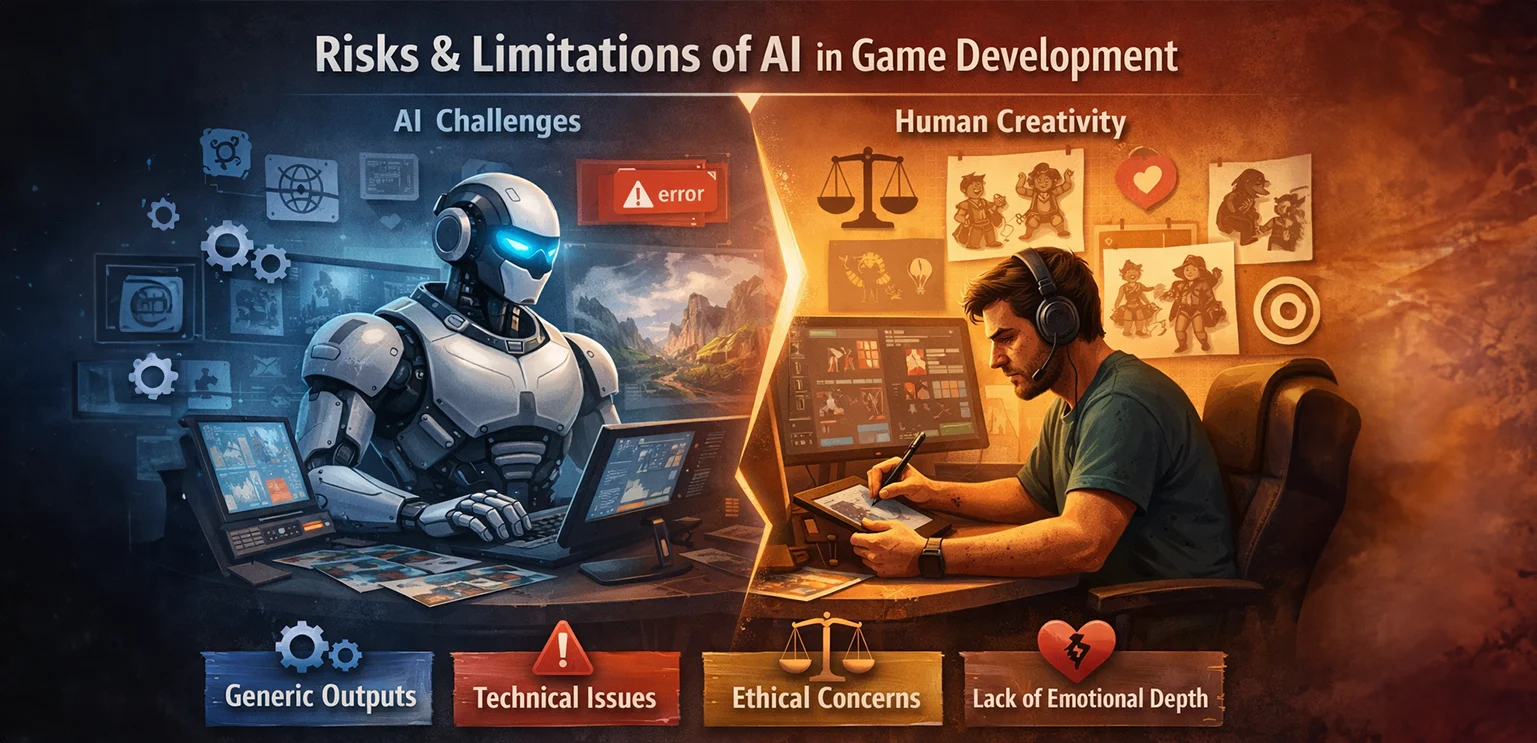
But while AI introduces powerful efficiencies, it also brings creative, technical, and ethical challenges. For studios aiming to build distinctive, high-quality games, understanding these limitations is just as important as exploring the benefits.
This article looks at where AI helps, where it struggles, and why human-led direction remains essential.
Where AI Is Making an Impact
AI tools are being used for:
- Rapid concept generation
- Asset variations and upscaling
- Procedural environment creation
- Automated testing and bug detection
- Player behavior analysis
These applications reduce production time and support faster prototyping. However, speed does not always translate into depth or originality.
The Creative Limitations of AI
🔹 Lack of Intent and Emotional Context
AI can generate visuals or mechanics, but it does not understand the narrative purpose behind them. It predicts patterns rather than designing with meaning. As a result, outputs often feel visually correct but creatively shallow.
🔹 Style Without True Identity
AI can mimic established styles, yet it struggles to create a consistent and recognizable artistic direction for an entire game. Strong visual identity still requires human art leadership.
🔹 Repetition and Familiarity
Because AI models learn from existing data, they tend to reproduce common design solutions. This can lead to worlds, characters, and interfaces that feel generic rather than memorable.
Technical and Production Challenges
🔹 Pipeline Integration
AI-generated assets often require extensive cleanup before they are ready for implementation. Topology issues, inconsistent layers, and export limitations can slow production instead of accelerating it.
🔹 Lack of System Awareness
Game development is not just asset creation — it is the interaction between mechanics, performance, UX, and narrative. AI tools typically operate in isolation and do not fully understand engine constraints or gameplay dependencies.
🔹 Quality Control Overhead
The more content AI produces, the more review time is needed. Without strong art direction and validation workflows, maintaining consistent quality becomes difficult.
Ethical and Legal Concerns
🔹 Data Source Transparency
Studios must ensure that generated assets do not create ownership or licensing conflicts.
🔹 Artist Displacement Fears
Over-automation can affect team morale and long-term creative culture if not handled with a collaboration-first mindset.
🔹 Player Perception
Many players value handcrafted experiences. Overuse of AI-generated content can impact brand authenticity if the output feels mass-produced.
Design Risks When AI Leads Instead of Assists
When AI is treated as a replacement rather than a tool:
- Visual direction becomes inconsistent
- Gameplay loses intentional pacing
- Narrative cohesion weakens
- UX decisions become data-driven but not player-driven
AI is most effective when guided by experienced designers, not when used as an autonomous creator.
The Balance: AI as a Production Partner
The strongest pipelines use AI for:
- Accelerating early exploration
- Generating controlled variations
- Handling repetitive production tasks
- Supporting testing and analytics
While humans lead:
- Art direction
- Gameplay design
- Narrative structure
- Player experience strategy
This hybrid approach maintains both efficiency and originality.
A Responsible AI-Integrated Workflow
Studios adopting AI successfully focus on:
- Clear creative ownership
- Structured review pipelines
- Ethical asset sourcing
- Transparent production methods
- Human-led final output
This ensures that technology enhances creativity rather than replacing it.
The Long-Term View
AI will remain a powerful part of game development, but it is not a complete solution. Games are built on emotion, intention, and player connection — areas where human creativity still leads.
The future is not AI versus developers. It is AI accelerating production while people define the experience.
Frequently Asked Questions
Will AI replace game artists and designers?
No. AI can assist with production speed, but creative direction, storytelling, and player experience require human expertise.
Is AI-generated game art production-ready?
Often, it needs significant refinement before it can be used in a real-time engine.
Can AI create a full game on its own?
AI can support many stages, but it cannot yet manage the interconnected systems that make a complete, polished game.
Does using AI reduce development costs?
It can reduce time in certain areas, but additional review, cleanup, and integration may offset some of those gains.
How do players feel about AI-generated content?
Players generally respond best when AI is used to enhance quality, not when it replaces the human touch.
What is the ideal role of AI in game development?
As a tool that speeds up production while human creators lead the vision and execution.