What Are the Hidden Costs of Slot Game Development?
When companies plan a new slot game, they usually focus on the obvious expenses—art production, animation, programming, and game mathematics. These are easy to identify because they are directly tied to building the game itself.
However, many projects exceed their original budgets not because of these visible costs, but because of hidden expenses that are overlooked during planning.
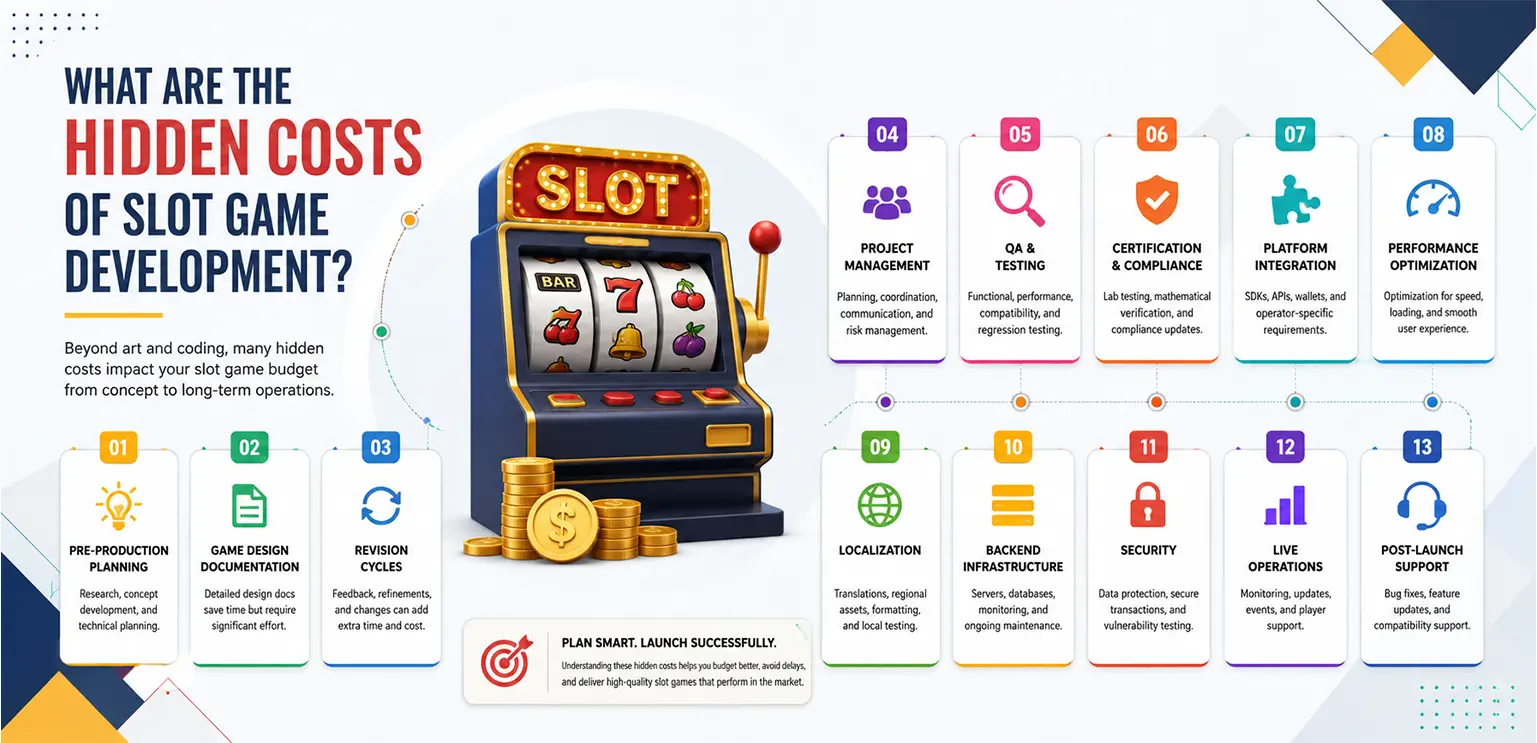
Certification, multiple revision cycles, platform integration, performance optimization, quality assurance, project management, localization, compliance, and post-launch support can all significantly increase the total cost of development. Individually, these expenses may appear manageable, but together they can represent a substantial portion of the overall project budget.
For startup studios and first-time casino operators, these hidden costs often come as an surprise. Even experienced game providers can underestimate the resources required when entering new regulated markets or developing more complex game mechanics.
Understanding these costs before development begins allows studios to create realistic budgets, avoid project delays, and make better business decisions throughout production.
In this guide, we'll explore the hidden costs of slot game development, explain why they occur, and share practical strategies for managing them without compromising quality.
Understanding the True Cost of Slot Game Development
The price quoted by a game development studio is rarely the total cost of bringing a slot game to market. Building the game is only one part of the investment. A complete production budget should also consider everything required to prepare, launch, maintain, and support the game throughout its lifecycle. These costs generally fall into two categories:
| Direct Costs | Hidden Costs |
|---|---|
| Concept art | Pre-production planning |
| UI/UX design | Project management |
| Animation | Revision cycles |
| Programming | Quality assurance |
| Math development | Certification |
| Audio production | Integration support |
| Basic testing | Performance optimization |
| Asset creation | Post-launch maintenance |
Both categories are essential, but hidden costs are often underestimated because they are spread across multiple stages of development.
Why Development Budgets Often Miss the Mark
Budget overruns are not always the result of poor financial planning. Often, they happen because teams underestimate the amount of work required outside of core production. Several factors contribute to this problem:
- The focus is placed on visible deliverables. Teams estimate artwork, programming, and animation accurately but overlook the work required to coordinate and refine these deliverables.
- Project requirements evolve. New feature requests, platform requirements, or regulatory changes may introduce additional work after development has already begun.
- Complexity increases during production. Features that appear straightforward during planning often require additional iterations once implementation begins.
- Operational costs continue after launch. Supporting a live game requires ongoing updates, maintenance, and monitoring that may not have been included in the original budget.
Recognizing these realities early helps create more realistic production plans.
Hidden Costs in Slot Game Development
🔹 Pre-Production Planning
One of the most overlooked investments in game development happens before production even begins. Pre-production establishes the foundation for the entire project. Skipping or rushing this phase often leads to expensive revisions later. Pre-production typically includes:
- Market research: Understanding player preferences, competitor games, and current market trends helps define a stronger product strategy.
- Game concept development: Teams refine gameplay ideas, bonus features, themes, and monetization goals before production starts.
- Feature planning: Developers determine which mechanics are technically achievable within the project's budget and timeline.
- Technical planning: Choosing the game engine, architecture, integrations, and production pipeline early reduces future development risks.
Although these activities don't immediately produce visible assets, they often save significant time and money later in the project.
🔹 Game Design Documentation
A detailed Game Design Document (GDD) requires time and expertise to produce, yet many teams underestimate its value. A strong GDD reduces misunderstandings between artists, developers, animators, mathematicians, and QA teams. Typical documentation includes:
- Gameplay rules.
- Paytable definitions.
- Feature descriptions.
- UI flow.
- Bonus mechanics.
- Audio requirements.
- Technical specifications.
- Platform requirements.
Without clear documentation, production teams often spend additional time clarifying requirements or correcting inconsistent implementations.
🔹 Revision Cycles
Very few slot games are completed exactly as originally planned.
- Artwork is refined.
- Animations are adjusted.
- Features evolve.
- UI layouts change.
- Mathematical balancing is updated.
Each revision requires additional production time.
Some common reasons for revisions include:
- Creative improvements: Teams refine visual quality as the project progresses.
- Client feedback: Publishers or casino operators request design adjustments before approval.
- Technical limitations: Certain features may require redesign after implementation.
- Gameplay improvements: Internal testing often identifies opportunities to improve player experience.
While revisions are a natural part of production, excessive review cycles can significantly increase development costs. Establishing clear approval milestones helps reduce unnecessary rework.
🔹 Project Management
Project management is frequently overlooked because it does not directly produce game assets. However, coordinating multiple departments is essential for keeping production on schedule. Project managers typically handle:
- Production scheduling: Coordinating artists, animators, developers, mathematicians, and QA teams to ensure work progresses smoothly.
- Resource planning: Assigning the right people to the right tasks while balancing workloads across multiple projects.
- Client communication: Managing approvals, feedback, milestone reviews, and production updates.
- Risk management: Identifying potential delays early and adjusting schedules before they impact delivery.
Effective project management helps control development costs by minimizing delays, reducing rework, and keeping production on schedule.
🔹 Technical Research and Prototyping
Not every feature works exactly as expected during development. Some mechanics require experimentation before full implementation begins. This may involve:
- Building prototype bonus features.
- Testing animation performance.
- Evaluating SDK compatibility.
- Measuring mobile performance.
- Validating backend communication.
- Testing new gameplay mechanics.
Although prototypes are rarely part of the final product, they help teams identify technical risks before investing heavily in production.
🔹 Tooling and Software
Professional slot game development relies on a wide range of production tools and commercial software. Common examples include:
- Digital illustration software.
- Animation tools.
- Game engines.
- Version control platforms.
- Project management software.
- Testing tools.
- Cloud storage.
- Collaboration platforms.
These ongoing operational costs are essential for maintaining efficient production but are often excluded from initial project estimates.
🔹 Internal Reviews and Quality Gates
Before assets move to the next production stage, they usually pass through multiple review processes. These quality gates help maintain consistency but require additional time from senior team members. Examples include:
- Art direction reviews.
- Animation approval.
- Technical validation.
- Code reviews.
- Gameplay evaluation.
- Production sign-off.
Although these reviews add to production costs, they significantly reduce the risk of expensive issues later in development.
Why These Early Investments Save Money
At first glance, planning, documentation, project management, and quality reviews may appear to increase development costs. In reality, they often reduce the budget of the total project. Early planning helps teams:
- Identify problems before production begins. Fixing issues during planning is usually much less expensive than making major changes after implementation.
- Reduce unnecessary revisions. Clear requirements minimize misunderstandings between different production teams.
- Improve scheduling accuracy. Better planning leads to more predictable timelines and resource allocation.
- Maintain consistent quality. Regular reviews help prevent costly rework near the end of development.
These early investments create a stronger foundation for the entire project and contribute to a smoother production process.
Quality Assurance (QA) and Testing
🔹 QA Testing Scope
Many people assume testing happens only after development is complete. In reality, quality assurance is an ongoing process that begins much earlier and continues throughout production. Skipping or reducing QA may lower costs initially, but it often leads to expensive bug fixes, delayed launches, and poor player experiences. A comprehensive QA process typically includes:
- Functional testing: Every gameplay feature, button, bonus round, and menu is tested to ensure it works as intended.
- Regression testing: Whenever developers fix a bug or add a new feature, previous functionality must be retested to confirm nothing else has been affected.
- Compatibility testing: The game is verified across different browsers, operating systems, screen resolutions, and mobile devices.
- Performance testing: Frame rates, loading times, memory usage, and responsiveness are evaluated to maintain a smooth experience.
- User experience validation: QA teams also check gameplay flow, readability, navigation, and visual consistency.
The earlier issues are detected, the easier and more cost-effective they are to fix.
Certification and Compliance
🔹 Regulatory Requirements
If a slot game is intended for regulated markets, certification becomes an essential part of the production budget. Independent testing laboratories review various aspects of the game before it can be released under specific gaming jurisdictions. Certification-related costs may include:
- Mathematical verification: The game's RTP, volatility, and statistical behavior are evaluated against documented specifications.
- Technical documentation: Development teams prepare reports, game specifications, and supporting materials required for testing.
- Compliance updates: Minor changes requested during the certification process may require additional development work.
- Retesting: If significant changes are made after certification begins, parts of the game may need to be tested again.
Preparing for certification from the beginning usually reduces both costs and approval timelines.
Platform Integration
🔹 Integration Complexity
Completing the game doesn't automatically mean it is ready for players. Before launch, the game often needs to integrate with one or more casino platforms, aggregators, or operator systems. Integration work may involve:
- SDK implementation: Connecting the game with platform-specific software development kits.
- Wallet integration: Ensuring bets, wins, and balances are processed correctly.
- API configuration: Allowing the game to communicate with external services.
- Authentication systems: Managing player sessions securely.
- Operator-specific requirements: Different platforms may require unique configurations or adjustments.
Supporting multiple operators can significantly increase integration effort if the game has not been designed with scalability in mind.
Performance Optimization
🔹 Optimization Necessity
A slot game that performs well during development may still require additional optimization before launch. Performance improvements help ensure smooth gameplay across desktop browsers, mobile devices, and tablets. Optimization often includes:
- Reducing asset sizes: Compressing textures, audio, and animations to improve loading speeds.
- Improving rendering performance: Optimizing graphics so the game runs efficiently on lower-powered devices.
- Memory optimization: Reduce memory usage to ensure smooth gameplay, faster performance, and greater stability across a wide range of devices.
- Network optimization: Improving communication between the frontend and backend developers to reduce delays.
Although optimization is rarely visible to players, it directly affects user satisfaction and retention.
Localization
🔹 Expanding to Multiple Markets
Many studios launch games in multiple countries to get a broader audience. Localization involves much more than simply translating text. Additional work may include:
- Translating interface elements: Menus, pay-tables, feature descriptions, and help screens.
- Adapting graphics: UI assets or promotional artwork may require localized versions.
- Formatting regional content: Currency symbols, date formats, and language-specific layouts often need adjustment.
- Testing localized versions: Verify each language version to ensure translations, layouts, and UI elements display correctly across all supported devices.
Planning for localization early reduces the effort required when entering new markets.
Backend Infrastructure
🔹 Server and System Requirements
Modern online slot games depend on reliable backend services that continue operating long after development is complete. These systems require ongoing investment. Backend-related costs may include:
- Server infrastructure: Supporting gameplay requests, player sessions, and integrations.
- Database management: Storing game history, transactions, and operational data securely.
- Monitoring systems: Tracking server health, uptime, and performance metrics.
- Maintenance updates: Keeping backend services secure, stable, and compatible with platform changes.
Although players rarely see these systems, they are critical for delivering a reliable gaming experience.
Security
🔹 Protecting Player Data
Security is often considered only after development begins, but protecting player data and financial transactions requires continuous investment. Common security-related activities include:
- Secure communication: Protecting data exchanged between the game and casino platforms.
- Authentication: Verifying player access and maintaining secure sessions.
- Access control: Restricting administrative functions to authorized personnel.
- Security testing: Identifying vulnerabilities before launch.
Strong security reduces operational risks and strengthens player confidence.
Live Operations
🔹 Ongoing Game Support
Game development doesn't end when the game goes live. Successful slot games require continuous operational support throughout their lifecycle. Typical live operations include:
- Monitoring game performance: Tracking uptime, stability, and technical health after launch.
- Bug fixes: Resolving issues discovered during real-world gameplay.
- Platform updates: Maintaining compatibility with changing operator or browser requirements.
- Content updates: Adding promotional events, seasonal assets, or feature improvements where applicable.
These ongoing activities should be considered part of the total cost of ownership.
Post-Launch Support
🔹 After-Launch Responsibilities
Even a successful launch generates additional responsibilities. Operators may request improvements, integrations, or technical assistance after deployment. Post-launch support often includes:
- Technical support: Assisting operators with configuration or integration questions.
- Feature enhancements: Improving gameplay based on player feedback or business requirements.
- Compatibility updates: Supporting new operating systems, browsers, or devices.
- Documentation updates: Maintaining technical and operational documentation as the game evolves.
Ignoring post-launch planning can create unexpected operational expenses later.
The Cost of Poor Planning
Some of the most expensive development costs are not tied to production—they result from avoidable mistakes. Poor planning often leads to:
- Repeated revisions: Unclear requirements force artists, developers, and QA teams to redo completed work.
- Missed deadlines: Delays increase project management costs and postpone revenue opportunities.
- Scope creep: Adding new features during development expands both budgets and timelines.
- Team inefficiency: Developers spend time solving preventable problems instead of building new functionality.
Good planning doesn't eliminate all risks, but it significantly reduces unnecessary spending throughout the project.
How to Reduce Hidden Development Costs
While hidden costs can't be eliminated completely, they can be managed through better planning and structured production processes. Some practical strategies include:
- Define project requirements before production begins. Clear objectives reduce misunderstandings and unnecessary revisions.
- Invest in documentation. Well-prepared design documents, technical specifications, and style guides improve collaboration across teams.
- Build quality assurance into the development process. Continuous testing identifies issues before they become expensive to fix.
- Plan for certification early. Designing with compliance requirements in mind helps avoid delays during approval.
- Use scalable production pipelines. Standardized workflows improve efficiency and simplify collaboration with external partners.
- Allocate contingency budgets. Setting aside a portion of the budget for unforeseen challenges provides greater financial flexibility.
Studios that anticipate hidden costs from the beginning are generally better positioned to deliver projects on time and within budget.
Can Outsourcing Help Reduce Hidden Costs?
Outsourcing is often viewed as a way to reduce development expenses, but its greatest value is often cost predictability rather than simply lowering the budget. An experienced game development partner already has established workflows, specialized talent, production tools, and quality assurance processes in place. Instead of building these capabilities from scratch, studios can leverage existing expertise and avoid many of the hidden costs associated with expanding an internal team. When managed effectively, outsourcing can help reduce costs related to:
- Recruitment and onboarding: Hiring experienced artists, developers, animators, and QA engineers takes time and resources. Working with an established partner provides immediate access to skilled professionals.
- Production delays: Teams with proven slot game experience can often identify potential issues earlier, reducing costly revisions and missed milestones.
- Software and infrastructure: External studios already invest in professional tools, production pipelines, and collaboration systems that clients would otherwise need to maintain.
- Specialized expertise: Rather than hiring full-time specialists for short-term needs, studios can access experts in mathematics, animation, optimization, certification support, or platform integration when required.
The goal isn't to outsource everything. It's to use external expertise strategically where it provides the greatest operational value.
The Hidden Cost of Choosing the Cheapest Development Partner
Keeping development costs low is important, but selecting a partner based only on the lowest price can create much larger expenses later. Lower project estimates sometimes exclude activities that become necessary during production, resulting in unexpected change requests, additional revisions, or delayed delivery. Some warning signs include:
- Unclear project scope: If deliverables are not clearly defined, additional work may be billed separately as the project evolves.
- Limited quality assurance: Reducing testing may lower initial costs but increase the risk of bugs, certification issues, or post-launch fixes.
- Lack of slot game experience: Teams unfamiliar with iGaming workflows may require additional revisions or encounter integration challenges.
- Weak documentation: Poor communication often leads to misunderstandings that increase production time and cost.
The lowest quote is not always the lowest total cost. Evaluating experience, production processes, and long-term reliability often leads to better value.
Budget Planning Best Practices
A realistic budget considers the entire lifecycle of a slot game, not just the initial development phase. Before production begins, studios should identify all major cost categories and plan for both expected and unexpected expenses. Some recommended practices include:
- Separate production and operational budgets. Development costs are only one part of the total investment. Live operations, maintenance, and support should also be planned.
- Allocate a contingency budget. Setting aside additional funds for unforeseen technical challenges or scope changes helps keep projects on track.
- Define approval milestones. Structured reviews reduce unnecessary revisions and improve cost control.
- Prioritize high-value features. Focusing resources on the mechanics that provide the greatest player impact helps maximize return on investment.
- Review costs throughout production. Regular budget reviews allow teams to identify potential issues before they become major financial problems.
Effective budgeting is not about eliminating every unexpected expense—it's about minimizing surprises through better planning.
Hidden Costs vs Smart Investments
Not every additional expense should be viewed as a problem. Some investments increase the initial budget while significantly reducing long-term costs. For example:
| Short-Term Investment | Long-Term Benefit |
|---|---|
| Detailed Game Design Document | Fewer misunderstandings and revisions |
| Early prototyping | Identifies technical risks before full production |
| Continuous QA testing | Reduces expensive bug fixes before launch |
| Performance optimization | Improves player experience across more devices |
| Certification planning | Speeds up regulatory approval and reduces rework |
| Scalable architecture | Makes future updates and integrations easier |
The key is understanding which costs create long-term value and which costs result from poor planning or inefficient workflows.
How Gamix Labs Helps Clients Control Development Costs
At Gamix Labs, cost management begins long before production starts. The focus is on building efficient workflows that reduce unnecessary revisions, improve collaboration, and support predictable project delivery. Rather than treating every project as a one-time engagement, the team emphasizes structured production processes that help clients achieve better long-term value. Key approaches include:
- Comprehensive pre-production planning: Clear project requirements, technical specifications, and production milestones reduce uncertainty throughout development.
- Experienced multidisciplinary teams: Artists, animators, developers, QA engineers, and technical specialists collaborate using established workflows designed for slot game production.
- Scalable production pipelines: Flexible resource allocation allows projects to grow without disrupting schedules or compromising quality.
- Quality assurance throughout development: Continuous testing helps identify issues early, reducing the cost of late-stage corrections.
- Platform-ready delivery: Games are developed with performance, integration, and certification requirements in mind, helping clients avoid unnecessary post-production challenges.
By combining technical expertise with efficient production management, Gamix Labs helps studios deliver high-quality slot games while keeping development budgets under better control.
Conclusion
The true cost of slot game development extends far beyond programming, art, and animation. Planning, documentation, project management, testing, certification, platform integration, optimization, live operations, and post-launch support all contribute to the overall investment required to bring a game to market successfully.
These hidden costs are not necessarily negative. Many of them are essential investments that improve quality, reduce risk, and support long-term business success. The challenge is not eliminating these costs—it is identifying them early and incorporating them into realistic production plans.
Studios that focus only on direct development costs often face unexpected expenses as the project progresses. By planning for the entire game development lifecycle—from pre-production and testing to certification, launch, and post-release support—they can manage budgets more effectively, reduce risks, and deliver high-quality games on schedule.
For casino operators, publishers, and development studios, understanding hidden costs leads to more informed decisions when selecting production partners, evaluating project budgets, and planning future game releases.
Ultimately, successful slot game development is not determined by the lowest initial quote—it is achieved through careful planning, efficient workflows, and strategic investment in every stage of production.
FAQs
What are hidden costs in slot game development?
Hidden costs are expenses that go beyond core production, including planning, documentation, quality assurance, certification, platform integration, optimization, maintenance, and post-launch support.
Why do slot game projects exceed their budgets?
Projects often exceed budgets because teams underestimate revisions, testing, compliance requirements, technical integrations, and operational support needed after development.
Is certification included in development costs?
Not always. Certification may involve additional testing, documentation, compliance updates, and laboratory fees depending on the target market and regulatory requirements.
Can outsourcing reduce hidden development costs?
Yes. Experienced development partners can reduce recruitment expenses, improve production efficiency, streamline workflows, and help avoid costly delays or rework.
Should startups budget for post-launch support?
Absolutely. Bug fixes, compatibility updates, technical support, and future improvements are all part of maintaining a successful live game.
How can studios control hidden costs?
By investing in detailed planning, maintaining clear documentation, testing continuously, preparing for certification early, and working with experienced production partners.