What Happens During Slot Game QA Testing?
Launching a slot game involves much more than creating attractive artwork, engaging animations, and balanced gameplay mechanics. Before a game reaches players, it must go through a structured quality assurance (QA) process to ensure every feature works as intended under real-world conditions.
QA testing is one of the most important stages of slot game development because it helps identify technical issues, gameplay inconsistencies, and usability problems before launch. A visually impressive game can still deliver a poor player experience if bonus features fail to trigger correctly, payouts are displayed inaccurately, or the game behaves differently across devices.
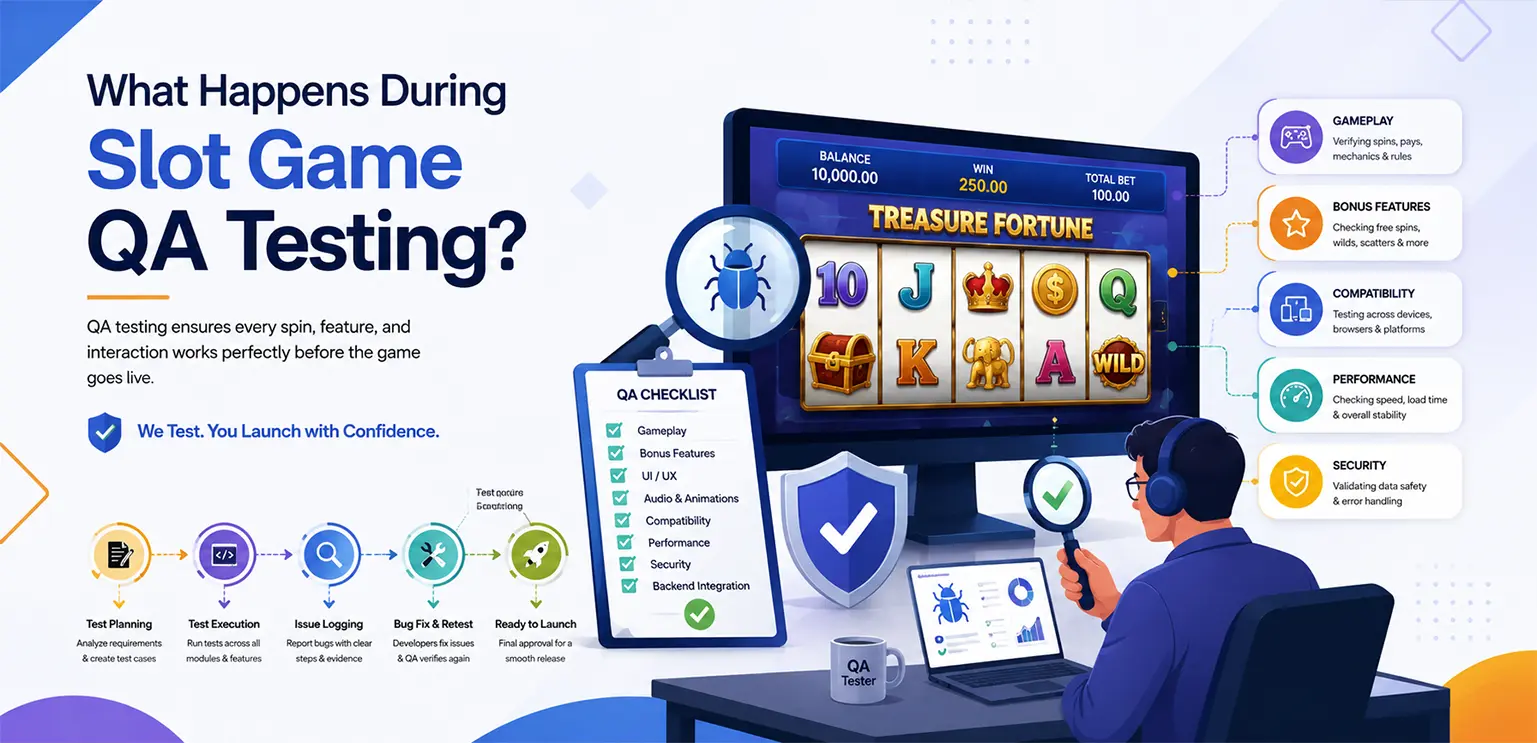
For casino operators, publishers, and game studios, QA is not simply about finding bugs. It is a continuous process that improves reliability, protects brand reputation, and supports a smoother launch across multiple platforms and jurisdictions.
In this guide, we'll explore what happens during slot game QA testing, the different types of QA testing involved, when QA begins during production, and why it plays a vital role in delivering high-quality casino games.
What Is Slot Game QA Testing?
Quality Assurance (QA) testing is the structured process of verifying that every part of a slot game functions correctly before it is released. The objective is not only to detect bugs but also to confirm that the game delivers the experience originally intended by the designers, developers, mathematicians, and product team. QA teams evaluate areas such as:
- Gameplay functionality.
- Bonus feature behavior.
- User interface consistency.
- Device compatibility.
- Performance.
- Stability.
- Technical reliability.
- Overall player experience.
Rather than testing the game once at the end of development, QA is performed throughout the production cycle to identify issues early when they are faster and less expensive to fix.
Why QA Is Critical Before Launch
Even relatively simple slot games contain thousands of possible gameplay scenarios. Different betting levels, feature combinations, bonus rounds, device types, browsers, operating systems, and player actions all create situations that need to be tested. Without comprehensive QA, problems may only become visible after release. Effective QA helps studios:
- Improve game stability: Detect crashes, freezes, loading issues, and unexpected behavior before players encounter them.
- Protect player trust: Consistent gameplay builds confidence in both the game and the casino platform.
- Reduce costly post-launch fixes: Finding issues during development is significantly less expensive than resolving them after release.
- Support certification readiness: Games that complete thorough QA generally move through certification more efficiently because many technical issues have already been addressed.
- Protect business reputation: Reliable game quality contributes to stronger operator relationships and positive player experiences.
QA is therefore both a technical requirement and a business investment.
QA Testing vs Simulation Testing vs Certification
These three processes are interconnected, but each focuses on a different aspect of ensuring a slot game is ready for release.
| Process | Primary Purpose |
|---|---|
| QA Testing | Verifies that the game functions correctly, remains stable, and delivers the intended player experience. |
| Simulation Testing | Validates the mathematical model by running millions of automated spins to evaluate RTP, volatility, hit frequency, and statistical behavior. |
| Certification Testing | Independent laboratories verify that the game complies with technical and regulatory requirements for approved markets. |
A simple way to understand the relationship is:
- QA confirms the game works correctly.
- Simulation confirms the mathematics behave correctly.
- Certification confirms the game meets regulatory requirements.
Although these processes support one another, they are not interchangeable.
When Does QA Begin?
One of the biggest misconceptions is that QA starts only after development is complete.
In reality, experienced studios integrate QA throughout the production lifecycle. A typical QA timeline includes:
🔹 During Pre-Production
QA teams review documentation, feature requirements, and technical specifications to identify potential risks before development begins.
🔹 During Development
As individual features become available, testers verify their functionality instead of waiting for the entire game to be completed.
This allows developers to resolve issues while the affected systems are still being actively developed.
🔹 During Feature Integration
Once multiple systems begin working together, QA focuses on identifying problems that only appear when different components interact. Examples include:
- Bonus features.
- Audio synchronization.
- UI behavior.
- Wallet communication.
- Backend integration.
🔹 Before Launch
Before launch, the final game build undergoes comprehensive testing across supported devices, browsers, operating systems, and gameplay scenarios to ensure a stable, consistent, and launch-ready player experience.
This final verification ensures the release version is ready for players.
What Does a QA Team Actually Test?
A modern slot game contains many independent systems working together simultaneously. QA teams examine each of these systems individually before evaluating how they interact. Some of the primary testing areas include:
- Core gameplay.
- User interface.
- Bonus features.
- Audio.
- Animation.
- Backend communication.
- Performance.
- Compatibility.
- Security.
- Stability.
Testing each area separately makes it easier to identify the source of technical issues.
Functional Testing
Functional testing confirms that every feature operates according to the original design. This is usually one of the largest areas of QA. Testers verify:
- Game launch: The game opens correctly from supported casino platforms.
- Bet controls: Players can increase, decrease, and confirm wagers correctly.
- Spin behavior: Every spin begins and ends as expected.
- Winning combinations: Pay lines, cluster wins, or other mechanics calculate correctly.
- Balance updates: Bets and winnings are accurately reflected after every completed spin.
- Menus and settings: Pay tables, help screens, sound controls, and game settings function properly.
Functional testing ensures the core gameplay experience remains reliable.
Bonus Feature Testing
Bonus rounds often involve the most complex gameplay mechanics. As a result, they receive significant QA attention. Typical bonus testing includes:
🔹 Free Spins
Testers verify:
- Correct trigger conditions.
- Accurate number of awarded spins.
- Retrigger behavior.
- Multiplier calculations.
- Feature completion.
🔹 Wild Features
QA checks:
- Wild placement.
- Sticky wild behavior.
- Expanding Wild functionality.
- Multiplier application.
🔹 Scatter Features
Testing confirms:
- Correct triggering conditions.
- Bonus activation.
- Payout calculations.
- Visual and audio synchronization.
🔹 Progressive Features
If the game includes jackpots or progressive mechanics, QA verifies:
- Contribution tracking.
- Trigger behavior.
- Jackpot display.
- Award processing.
Because bonus features often involve multiple interconnected systems, they require particularly thorough testing.
User Interface (UI) Testing
Players interact with the user interface (UI) throughout every stage of gameplay. Even minor interface issues can disrupt navigation, reduce usability, and negatively impact the overall player experience. QA teams verify:
- Button responsiveness.
- Layout consistency.
- Text readability.
- Icon placement.
- Menu navigation.
- Mobile responsiveness.
- Landscape and portrait behavior were supported.
A well-designed interface should remain intuitive across all supported devices.
Animation Testing
Animations are a key part of the player experience in modern slot games. QA testing ensures every animation is visually accurate, properly synchronized, and performs smoothly throughout gameplay. Testing includes:
- Reel spin timing.
- Win animations.
- Bonus transitions.
- Character animation.
- Particle effects.
- Symbol movement.
- Animation interruptions.
- Synchronization with gameplay events.
Smooth animation contributes to a polished player experience.
Audio Testing
Sound effects and music help reinforce gameplay events. QA verifies:
- Correct sound playback.
- Audio synchronization.
- Volume controls.
- Music transitions.
- Feature-specific sound effects.
- Muting behavior.
Audio issues may seem minor but can significantly reduce overall game quality.
Early Bug Reporting and Collaboration
Finding bugs is only one part of QA. Every issue must also be documented clearly so developers can reproduce, investigate, and resolve it efficiently. A typical bug report includes:
- Description of the issue: What happened and why it is considered incorrect.
- Steps to reproduce: The exact sequence of actions needed to trigger the problem.
- Expected result: How the feature should behave according to the design.
- Actual result: What actually occurred during testing.
- Supporting evidence: Screenshots, videos, logs, or error messages that help developers identify the root cause.
Clear bug reporting improves communication between QA engineers, developers, designers, and project managers, reducing the time required to resolve issues.
Compatibility Testing
A modern slot game should provide a consistent experience across all supported platforms and devices. Whether players access the game on a desktop, smartphone, tablet, or different web browser, every version should perform reliably and deliver the same gameplay experience. Compatibility testing ensures the game functions correctly across all supported environments without compromising performance, visuals, or usability. QA teams typically test:
- Browser compatibility: The game is checked on supported browsers such as Chrome, Edge, Firefox, and Safari to ensure graphics, animations, and gameplay remain consistent.
- Operating systems: Testing covers Windows, Android, iOS, and macOS where applicable, confirming that platform-specific differences do not affect gameplay.
- Screen resolutions: The interface should scale properly across various screen sizes without overlapping elements or unreadable text.
- Touch and mouse controls: Mobile gestures and desktop interactions should both feel responsive and intuitive.
A game that works perfectly on one device but fails on another can lead to player frustration and negative operator feedback.
Performance Testing
Visual appeal alone isn't enough to deliver a great slot game experience. If a game loads slowly, lags during gameplay, or struggles to run smoothly, it can quickly impact player satisfaction and retention. Performance testing evaluates how efficiently the game uses system resources to ensure stable, responsive, and consistent gameplay across all supported devices. Areas commonly tested include:
- Loading speed: Measuring how quickly the game starts and transitions between screens.
- Frame rate stability: Ensuring animations remain smooth during normal gameplay and bonus features.
- Memory usage: Monitors memory consumption to identify leaks or excessive usage that could impact performance, stability, or cause crashes.
- CPU utilization: Confirming that the game performs efficiently on both high-end and lower-powered devices.
- Long play sessions: Running the game continuously to detect issues that appear only after extended gameplay.
Good performance contributes directly to player retention and overall satisfaction.
Backend and Integration Testing
Most online slot games communicate continuously with external systems. These interactions must be reliable because they affect player balances, game history, and reporting. Backend testing verifies that the game exchanges data correctly with supporting services. Common checks include:
- Wallet communication: Bets are deducted accurately, winnings are credited correctly, and balances remain synchronized.
- Session management: Player sessions begin, resume, and end without errors.
- Game history: Spin results, transactions, and player activity are recorded correctly.
- API communication: Requests between the game and backend services return expected responses without delays or data inconsistencies.
- Error handling: The game responds gracefully if backend services become temporarily unavailable.
Reliable integration is essential for both operators and players.
Regression Testing
Every software update has the potential to introduce unexpected issues. Regression testing ensures that existing features continue to work correctly after new functionality is added or bugs are fixed. For example:
- A developer corrects a free spins issue.
- QA retests free spins.
- QA also verifies reels, wilds, payouts, UI behavior, and balance updates to ensure nothing else has changed unexpectedly.
Regression testing is repeated throughout development because every modification has the potential to affect other parts of the game.
This process helps maintain stability as development progresses.
Smoke Testing
Before starting detailed QA, teams perform smoke testing to verify that the latest game build is stable and ready for more comprehensive testing. It acts as an initial health check to identify any critical issues early. Typical smoke tests verify:
- The game launches successfully.
- Players can log in where required.
- Basic navigation works.
- Spins complete normally.
- Core menus are accessible.
- No critical crashes occur during startup.
If the game fails smoke testing, detailed QA is postponed until the most serious issues are resolved.
Exploratory Testing
Not every issue can be discovered using predefined test cases. Experienced QA engineers also perform exploratory testing, where they interact with the game more like real players. Instead of following a fixed script, they intentionally try unusual actions to uncover unexpected behavior. Examples include:
- Rapidly changing bet amounts before spinning.
- Opening multiple menus during bonus features.
- Repeatedly interrupting animations.
- Switching network conditions during gameplay.
- Performing actions in unexpected sequences.
Exploratory testing often identifies edge cases that automated or scripted testing may overlook.
Cross-Browser and Mobile Testing
Player expectations are simple: the game should work the same everywhere. To achieve this, QA verifies consistency across different environments. Testing includes:
| Desktop Browsers | Mobile Browsers | Tablets |
|---|---|---|
| Graphics render correctly. | Touch responsiveness. | Layout scaling. |
| Audio functions properly. | Gesture behavior. | Button spacing. |
| Animations remain synchronized. | Screen orientation. | UI readability. |
| Performance stays consistent. | Mobile performance. | Gameplay consistency. |
| — | Battery efficiency where relevant. | — |
Visual and Art Quality Testing
Slot games rely heavily on visual presentation. Even when gameplay functions correctly, inconsistent artwork or animation can reduce perceived quality. QA reviews visual assets for:
- Graphic quality: Symbols, backgrounds, and UI elements should appear sharp without distortion or compression artifacts.
- Alignment: Icons, text, buttons, and animations should be positioned correctly across all screen sizes.
- Animation consistency: Motion should appear smooth without clipping, flickering, or unexpected interruptions.
- Color and lighting: Visual elements should match the approved art direction and maintain consistency throughout the game.
- Typography: Fonts should remain readable in every language and resolution.
This stage helps ensure the final product reflects the intended artistic vision.
Error Handling and Recovery Testing
Unexpected situations can occur during gameplay, and the game should respond appropriately instead of crashing or becoming unresponsive. QA evaluates how the game behaves when problems occur. Typical scenarios include:
- Temporary internet disconnections.
- Browser refreshes during gameplay.
- Interrupted bonus features.
- Unexpected backend responses.
- Session timeouts.
The objective is to verify that players can continue safely or receive clear feedback without losing important game data.
Continuous QA Throughout Development
Modern QA is no longer limited to the final weeks before launch. Instead, testing is integrated throughout the development lifecycle. A continuous QA approach provides several advantages:
- Identify issues early: Detecting problems during development allows teams to resolve them quickly, reducing rework, preventing delays, and minimizing the impact on other systems.
- Faster feedback for developers: Regular testing helps identify issues soon after implementation, making them easier and quicker to resolve.
- Quality improves incrementally: Each production milestone is verified before moving to the next stage.
- Launch preparation becomes smoother: Fewer unresolved issues remain when the game enters final testing.
Continuous QA supports a smoother development process by detecting issues early, reducing delays, and ensuring the game is better prepared for launch.
Common QA Mistakes That Delay Launches
Even experienced development teams can encounter avoidable testing problems. Some of the most common include:
🔹 Waiting Until Development Is Finished
Testing only after production is complete often results in large numbers of issues being discovered simultaneously, making them more difficult to resolve.
🔹 Ignoring Edge Cases
Players do not always interact with games as designers expect.
Unusual actions and unexpected combinations should be tested alongside standard gameplay.
🔹 Limited Device Coverage
Testing on only a few devices increases the risk of compatibility issues appearing after launch.
🔹 Poor Bug Documentation
Incomplete reports slow down development because programmers cannot easily reproduce the issue.
Clear documentation accelerates debugging and improves communication.
🔹 Prioritizing Speed Over Quality
Meeting a release date is important, but releasing a game with significant technical issues can damage player trust and create additional costs after launch. Maintaining quality throughout development is generally more efficient than fixing large numbers of issues later.
QA Best Practices for Slot Game Studios
Studios with mature QA processes typically follow several common principles:
- Start testing early: Integrating QA from the beginning reduces expensive late-stage corrections.
- Use structured test cases: Standardized procedures improve consistency and make progress easier to measure.
- Combine manual and automated testing: Automation improves efficiency, while manual testing identifies gameplay and usability issues that tools may miss.
- Maintain close collaboration: QA engineers, developers, designers, mathematicians, and project managers should communicate regularly throughout production.
- Track quality metrics: Monitoring defect trends, resolution times, and recurring issues helps teams identify improvement opportunities and enhance future development processes.
These practices create a more reliable development pipeline and contribute to higher-quality game releases.
How QA Supports Certification Readiness
Although QA testing and certification have different objectives, they work together to prepare a slot game for a successful launch. QA focuses on validating the game's functionality, stability, and overall quality, while certification independently verifies its compliance with regulatory, technical, and mathematical standards. A comprehensive QA process helps identify and resolve issues early, making the game better prepared for certification and reducing the risk of delays or unnecessary rework. QA contributes to certification readiness by:
- Verifying gameplay stability: A stable game is less likely to require technical corrections during certification.
- Checking feature consistency: Every bonus feature, payout, and gameplay mechanic should behave exactly as described in the Game Design Document.
- Reviewing technical requirements: QA ensures the game follows platform guidelines and technical specifications before submission.
- Supporting documentation: Bug reports, testing records, and validation results provide valuable references throughout the development process.
While QA cannot guarantee certification approval, it significantly improves the chances of a smoother review process.
A Typical Pre-Launch QA Checklist
Before a slot game is released, QA teams perform one final verification to confirm the production build is ready for players. Although every studio has its own workflow, a comprehensive checklist usually includes:
🔹 Gameplay
- Every spin completes successfully.
- Winning combinations calculate correctly.
- Bet limits function as intended.
- Balance updates accurately.
- Paytables match actual gameplay.
🔹 Bonus Features
- Free Spins trigger correctly.
- Wild mechanics behave as designed.
- Scatter features activate consistently.
- Multipliers calculate accurately.
- Bonus rounds complete without errors.
🔹 User Interface
- Buttons respond correctly.
- Menus open without delays.
- Help screens display accurate information.
- Text remains readable across supported resolutions.
- Icons and visual elements are correctly aligned.
🔹 Performance
- The game loads efficiently.
- Frame rates remain stable.
- Memory usage stays within acceptable limits.
- Long play sessions do not introduce instability.
🔹 Compatibility
- Desktop browsers perform consistently.
- Mobile devices display the interface correctly.
- Tablet layouts remain responsive.
- Audio and animations function across all supported platforms.
🔹 Backend
- Wallet integration works correctly.
- Player sessions remain stable.
- Game history is recorded accurately.
- API communication is reliable.
Completing these checks helps reduce the risk of unexpected issues after launch.
Why QA Is More Than Bug Testing
Many people assume QA simply means finding bugs. In reality, quality assurance is about validating the entire player experience. A QA engineer evaluates questions such as:
- Is the gameplay intuitive?
- Do feature transitions feel natural?
- Is every interaction responsive?
- Can new players easily understand the interface?
- Does the game perform consistently under different conditions?
This broader perspective helps ensure the game is not only technically correct but also enjoyable to play. For casino operators, a polished player experience can contribute to stronger engagement, improved retention, and greater confidence in the game provider.
The Business Value of QA
Investing in QA provides benefits that extend well beyond technical quality. From a business perspective, effective testing can help:
- Protect brand reputation: Stable, high-quality games strengthen relationships with operators and players.
- Reduce operational costs: Identifying issues before launch is generally much less expensive than resolving them in production.
- Accelerate time-to-market: Continuous testing reduces the number of critical issues discovered during the final stages of development.
- Improve player satisfaction: Smooth gameplay, responsive controls, and reliable features contribute to a better overall experience.
- Support long-term partnerships: Consistently delivering stable products increases confidence among publishers, aggregators, and casino operators.
QA should be viewed as a strategic investment that enhances game quality, reduces development risks, and contributes to a more successful product launch.
Common QA Metrics Studios Monitor
Many development teams measure QA performance using key quality indicators. These metrics help identify trends, improve workflows, and maintain consistent production standards. Common examples include:
- Bug discovery rate: Tracks how many issues are identified during different stages of development.
- Bug resolution time: Measures how quickly reported issues are fixed and verified.
- Regression rate: Indicates how often previously resolved issues reappear after updates.
- Critical defect count: Monitors the number of severe issues remaining before launch.
- Test coverage: Evaluates how much of the game's functionality has been validated through structured testing.
Reviewing these metrics regularly helps studios improve both product quality and development efficiency.
How Gamix Labs Approaches QA Testing
At Gamix Labs, QA is integrated throughout the production pipeline rather than being treated as the final development stage. The objective is to identify issues early, maintain consistent quality, and help clients deliver stable, launch-ready slot games. The QA process supports multiple areas of production, including:
- Gameplay validation: Verifying that core mechanics, pay lines, bonus features, and player interactions behave as intended.
- Cross-platform testing: Confirming consistent performance across supported browsers, operating systems, and mobile devices.
- Visual quality checks: Reviewing artwork, UI elements, animations, and effects to ensure they match approved production standards.
- Performance verification: Monitoring loading times, memory usage, and gameplay stability across different environments.
- Collaborative issue tracking: Working closely with artists, developers, and project managers to resolve issues efficiently throughout development.
This integrated approach helps reduce late-stage revisions and supports a smoother path toward launch and certification readiness.
Conclusion
Quality Assurance is one of the most important stages of slot game development because it ensures the game is stable, reliable, and ready for players before release. While art, animation, mathematics, and programming define what a slot game becomes, QA confirms that every part of the experience works together as intended.
Modern QA goes far beyond finding technical bugs. It validates gameplay mechanics, bonus features, user interfaces, backend communication, performance, compatibility, and the overall player experience across a wide range of devices and scenarios.
Studios that integrate QA throughout development typically experience fewer delays, lower post-launch maintenance costs, and smoother certification processes. More importantly, they deliver games that inspire confidence among casino operators and provide players with a polished, enjoyable experience from day one.
As competition in the iGaming industry continues to grow, consistent quality has become a key differentiator. Investing in structured QA processes is not simply about preventing problems—it's about building better games, protecting brand reputation, and creating products that succeed in the market.
FAQ: What Happens During Slot Game QA Testing?
What is QA testing in slot game development?
QA testing is the process of verifying that a slot game functions correctly, performs reliably, and delivers the intended player experience before launch.
When does QA testing begin?
QA should begin early in development, starting with feature validation and continuing through integration, optimization, and final release testing.
Is QA testing the same as certification?
No. QA is performed internally to identify and resolve issues, while certification is conducted by independent testing laboratories to verify compliance with regulatory and technical standards.
What types of testing are included in slot game QA?
QA commonly includes functional testing, compatibility testing, performance testing, regression testing, backend testing, UI testing, animation testing, audio testing, exploratory testing, and security validation.
Why is regression testing important?
Regression testing ensures that fixing one issue or adding a new feature does not unintentionally affect existing functionality elsewhere in the game.
How does QA improve player experience?
QA helps deliver stable gameplay, responsive controls, accurate payouts, consistent performance, and intuitive interfaces, all of which contribute to a smoother and more enjoyable gaming experience.