Choosing the Right RTP & Volatility for Global Slot Markets
Introduction: Why RTP and Volatility Decisions Define Slot Success
In slot game development, visuals may attract players—but math keeps them playing. Two of the most critical components of slot math design are:
- RTP (Return to Player)
- Volatility (Variance)
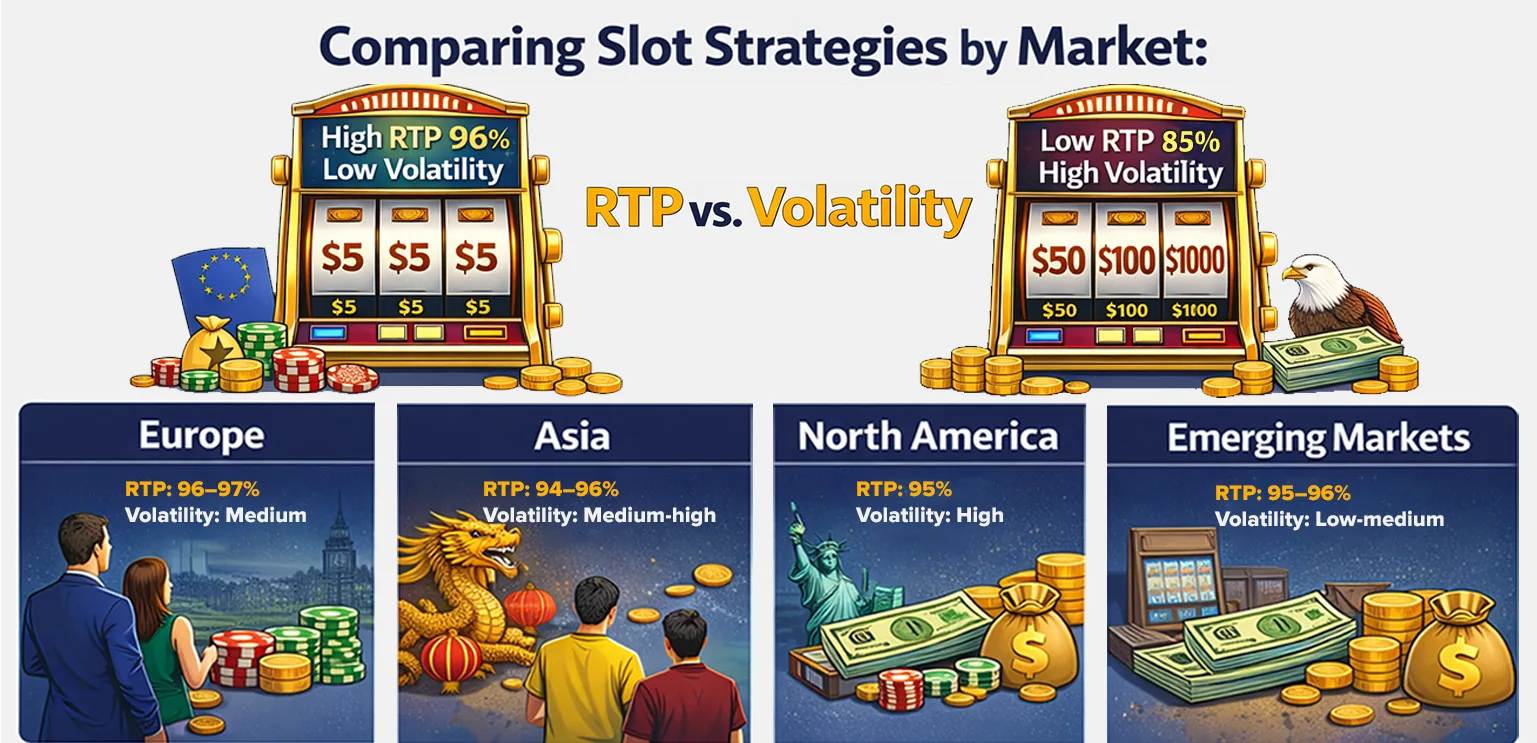
Together, these define how a game feels, how often players win, and how long they stay engaged.
Yet one of the most overlooked realities in iGaming is this: There is no “perfect” RTP or volatility setting that works globally.
A slot game that performs well in the UK might under-perform in Asia. A high-volatility game that excites one audience may frustrate another. For game studios and iGaming product teams, success depends on understanding:
- Player psychology
- Regional preferences
- Regulatory environments
- Session behavior patterns
This article explores how experienced studios choose RTP and volatility settings tailored to different player markets—and how to design flexible systems that scale globally.
Industry Context: The Evolution of Slot Math Strategy
Historically, slot games were simpler. Developers often used:
- Fixed RTP (e.g., 96%)
- Standard volatility profiles
But today’s market is far more sophisticated.
Operators demand:
- Multiple RTP configurations
- Flexible volatility tuning
- Market-specific adjustments
Simultaneously, players have become more informed.
They compare games based on:
- RTP percentages
- Hit frequency
- Perceived fairness
This has made math design a strategic differentiator rather than a technical detail.
Understanding RTP and Volatility in Practice
Before diving into market strategies, let’s clarify how these concepts work together.
🔹 What Is RTP?
RTP represents the percentage of total bets a slot returns to players over time.
Example:
- RTP = 96%
- For every $100 wagered, the game returns $96 (on average)
Important:
RTP is calculated over millions of spins, not individual sessions.
🔹 What Is Volatility?
Volatility defines how payouts are distributed.
- Low volatility: frequent small wins
- High volatility: rare but large wins
- Medium volatility: balanced distribution
Two games can have the same RTP but feel completely different depending on volatility.
Why RTP and Volatility Must Be Market-Specific
Different player markets exhibit different behaviors. Factors include:
- Cultural preferences
- Spending habits
- Session length
- Risk tolerance
- Regulatory constraints
Designing a single math model for all markets often leads to suboptimal performance.
Market Segmentation: How Player Preferences Vary Globally
1. European Markets (UK, Germany, Scandinavia)
🔹 Player Behavior
- Value transparency and fairness
- Prefer longer play sessions
- Moderate risk tolerance
🔹 RTP Expectations
- 95% – 97% RTP
- Lower RTP games may face resistance
🔹 Volatility Preference
- Medium volatility
- Balanced win distribution
Players prefer steady engagement over extreme risk.
2. North American Markets (US, Canada)
🔹 Player Behavior
- Influenced by land-based casino experiences
- Enjoy high-impact wins
- Shorter but more intense sessions
🔹 RTP Expectations
- Slightly lower acceptable RTP in some contexts
- Strong focus on entertainment value
🔹 Volatility Preference
- Medium to high volatility
- Big win potential is a key driver
3. Asian Markets
🔹 Player Behavior
- Strong preference for high-reward gameplay
- Culturally aligned with luck-based systems
- Fast-paced engagement
🔹 RTP Expectations
- Less focus on RTP visibility
- More focus on win potential
🔹 Volatility Preference
- High volatility
- Large jackpot-style wins
These markets often favor high-risk, high-reward mechanics.
4. Emerging Markets (Latin America, Africa)
🔹 Player Behavior
- Price-sensitive
- Mobile-first
- Shorter sessions
🔹 RTP Expectations
- Balanced RTP
- Value-driven gameplay
🔹 Volatility Preference
- Low to medium volatility
- Frequent wins help retain players
Designing Multi-RTP Slot Games
Most modern slot games support multiple RTP configurations. Example:
- 96% RTP (default)
- 94% RTP (regulated markets)
- 92% RTP (operator preference)
This allows operators to:
- Adjust margins
- Meet regulatory requirements
- Optimize performance per market
However, changing RTP requires careful math balancing.
How Volatility Impacts Player Retention
🔹 Low Volatility
Pros:
- Frequent wins
- Longer sessions
- Lower frustration
Cons:
- Less excitement
- Lower peak moments
🔹 High Volatility
Pros:
- Big win potential
- Strong emotional engagement
Cons:
- Higher churn risk
- Shorter sessions
🔹 Matching Volatility to Market Behavior
- Casual players → low volatility
- Experienced players → high volatility
Real Example: Market-Based RTP & Volatility Strategy
🔹 Base Game Configuration
- RTP: 96%
- Volatility: medium
🔹 Market Adjustments
| Market | RTP | Volatility |
|---|---|---|
| Europe | 96–97% | Medium |
| North America | 94–96% | Medium-high |
| Asia | 95% | High |
| Emerging Markets | 95–96% | Low-medium |
🔹 Outcome
The same game performs differently across markets due to math tuning.
Feature Design and Volatility
Volatility is heavily influenced by feature design. Examples:
- Free spins → medium volatility
- Multipliers → increased volatility
- Jackpot features → high volatility
Feature roadmaps must align with target volatility profiles.
Art and Perception: The Hidden Layer of RTP Design
Interestingly, visual design also affects how players perceive RTP.
- Large win animations create excitement
- Near-miss visuals increase engagement
- Bonus anticipation builds tension
Studios specializing in slot art production, such as Gamix Labs, often design visual feedback systems that enhance perceived value—making wins feel more impactful regardless of actual payout size.
This demonstrates how math and art must work together.
Regulatory Constraints on RTP
Some jurisdictions enforce rules such as:
- Minimum RTP thresholds
- Fixed RTP configurations
- Restrictions on volatility extremes
Developers must ensure compliance during game design.
Common Mistakes in RTP and Volatility Design
🔹 Using a Single Global Configuration
This ignores regional differences.
🔹 Misaligned Feature Design
Features may not match intended volatility.
🔹 Over-Optimizing for RTP
Higher RTP does not always mean better engagement.
🔹 Ignoring Player Psychology
Math models must align with emotional gameplay experiences.
Best Practices for Slot Math Design
🔹 Test Across Multiple Markets
Use simulations and A/B testing to evaluate performance.
🔹 Build Flexible Math Models
Allow RTP and volatility adjustments without rebuilding the game.
🔹 Align Math with Feature Roadmaps
Ensure future features support the intended volatility profile.
🔹 Collaborate Across Teams
Math designers, game designers, and art teams must work together.
Future Trends in RTP and Volatility Design
🔹 Personalized Game Experiences
Future systems may adjust volatility dynamically based on player behavior.
🔹 Data-Driven Optimization
Studios are increasingly using analytics to refine RTP strategies.
🔹 Hybrid Volatility Models
Games may shift between volatility levels during gameplay.
Conclusion
Choosing the right RTP and volatility is not just a technical decision—it’s a strategic one. Different player markets have different expectations, behaviors, and risk profiles.
Studios that understand these differences can:
- Improve player retention
- Increase engagement
- Optimize revenue
The most successful slot games are not those with the highest RTP or the most extreme volatility—but those that align math design with player psychology and market dynamics.
FAQ: RTP & Volatility in Slot Games
What is RTP in slot games?
RTP (Return to Player) is the percentage of total bets that a slot game returns to players over time.
What is volatility in slot games?
Volatility refers to how often and how much a slot pays out, ranging from frequent small wins to rare large wins.
Which RTP is best for slot games?
Most successful slot games use RTP between 94% and 97%, depending on market and regulatory requirements.
Do different markets prefer different volatility levels?
Yes. For example, Asian markets often prefer high volatility, while European players prefer balanced gameplay.
Can RTP be changed after a game is built?
Yes, but it requires predefined configurations and may need certification approval in regulated markets.
How does volatility affect player retention?
Low volatility improves session length, while high volatility increases excitement but may lead to faster player churn.