Slot Game Feature Roadmaps: MVP to Live Ops Strategy
Introduction: Why Feature Roadmaps Matter More Than Ever in Slot Development
In the early days of online casino games, a slot title could launch with a simple formula: five reels, a few pay-lines, and maybe a free spins feature. That was enough to compete.
Today, that approach rarely survives beyond launch week. Modern iGaming markets are driven by continuous engagement, player retention, and content evolution. Players expect new mechanics, dynamic bonuses, seasonal events, and ongoing improvements long after the initial release.
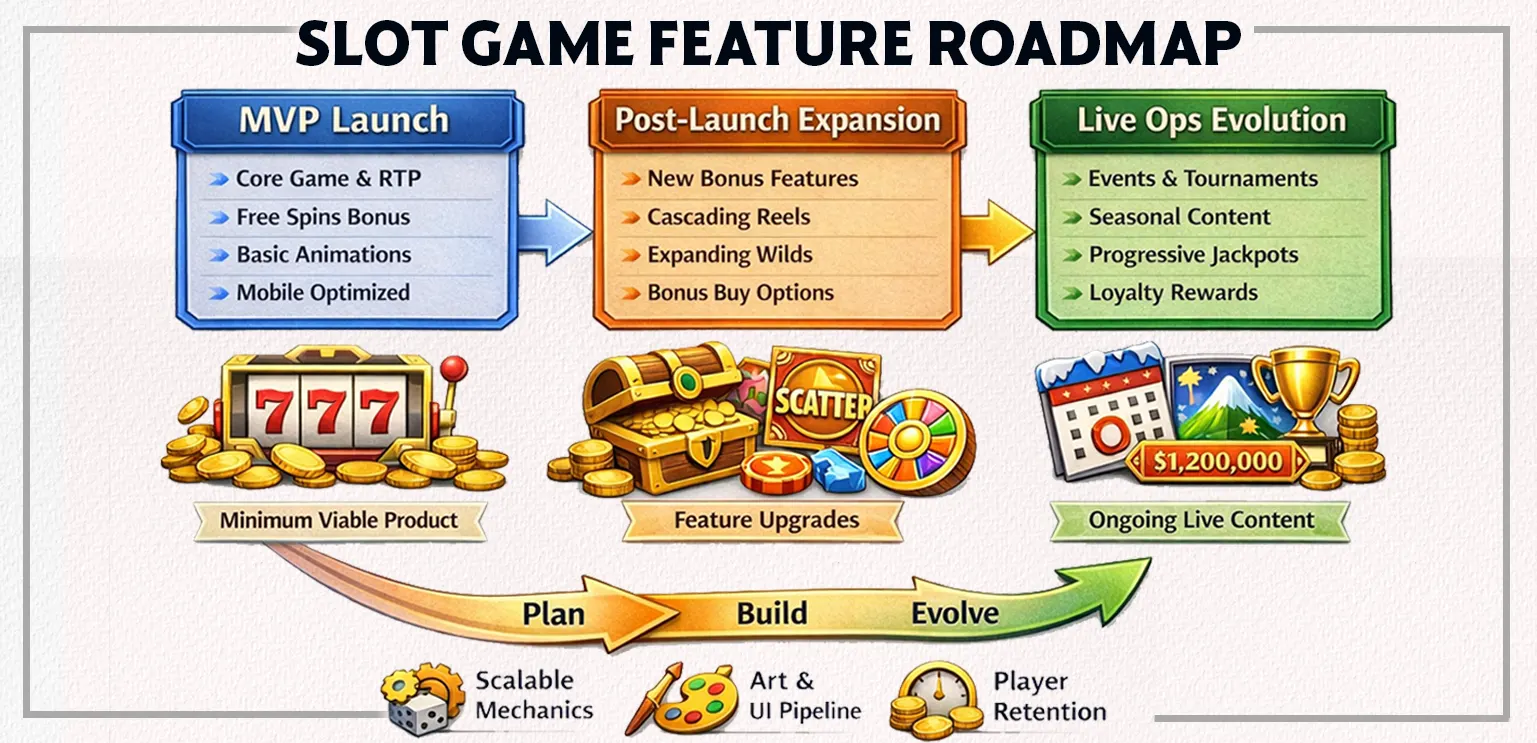
For game studios, this means a slot game is no longer a static product—it’s a long-term service. And like any live service product, success depends heavily on how features are planned, sequenced, and evolved. This is where feature roadmaps become critical.
A well-designed slot feature roadmap ensures that:
- The MVP launches quickly without unnecessary complexity
- Core features support long-term scalability
- Live operations teams can introduce new mechanics without breaking the game economy
- Art, animation, and UI pipelines remain efficient
For studios competing in regulated markets and social casino ecosystems, the difference between a one-off release and a long-term revenue-generating slot title often lies in how well the feature roadmap is planned.
Industry Context: The Rise of Live Ops in Casino Games
Live operations (Live Ops) have transformed many gaming genres, especially mobile and free-to-play titles. Now, the same transformation is happening in iGaming.
🔹 Operators increasingly expect slot providers to deliver:
- Seasonal events
- New bonus mechanics
- Daily challenges
- Tournament integrations
- Player progression systems
Even in regulated casino environments, Live Ops mechanics are becoming essential for maintaining player engagement.
🔹 From a studio perspective, this shift changes the development mindset:
Instead of launching a finished game, studios launch a platform that evolves.
This creates a new requirement: feature planning must extend far beyond the initial release.
🔹 Without a roadmap, studios face problems such as:
- Feature conflicts
- Math model instability
- Art production bottlenecks
- Live Ops content limitations
The most successful slot developers treat feature planning as a multi-stage roadmap, starting with an MVP and gradually expanding the experience.
What Is a Slot Game Feature Roadmap?
A slot feature roadmap is a structured plan that defines how gameplay mechanics evolve from the initial launch to long-term Live Ops support.
🔹 It answers questions such as:
- What mechanics must exist at launch?
- Which features can be added later?
- How will future features integrate with the math model?
- What art and UI systems must support expansion?
🔹 A roadmap typically covers three major development stages:
- MVP (Minimum Viable Product)
- Post-Launch Expansion
- Live Ops Feature Evolution
Each stage has different priorities and development constraints.
Stage 1: Designing the MVP Slot Game
The MVP stage focuses on launching a stable, engaging game as quickly as possible. The goal is not to deliver every possible mechanic, but to validate the game concept and core player experience.
🔹 Typical MVP Feature Set
Most MVP slot games include:
- Base game reels
- Core payline or ways system
- One primary bonus mechanic
- Free spins feature
- Basic win animations
- RTP configuration
- Mobile optimization
At this stage, simplicity is a strength.
Overloading the MVP with too many mechanics often creates problems such as:
- Math model instability
- Certification delays
- Production complexity
Experienced studios intentionally leave room for future feature expansion.
🔹 Designing an Expandable Core Game Loop
A successful MVP still needs a strong gameplay loop. The core loop generally looks like:
Spin → Win → Trigger Feature → Reward → Repeat
The roadmap question becomes:
Can this loop support future features?
For example: A basic free spins feature may later evolve into:
- Multiplier free spins
- Sticky wild spins
- Feature pick bonuses
- Progressive jackpots
If the core architecture supports modular mechanics, adding these features becomes much easier.
Stage 2: Post-Launch Feature Expansion
Once the game launches, studios begin introducing secondary features designed to increase engagement. These additions often include mechanics that were originally planned but intentionally postponed to speed up launch.
🔹 Common Post-Launch Features
Examples include:
- Expanding wild mechanics
- Cascading reels
- Feature multipliers
- Bonus wheel mechanics
- Mystery symbols
- Bonus buy options (where allowed)
These features extend gameplay without fundamentally changing the original math model.
The key challenge is ensuring new features integrate safely with the existing probability system.
🔹 Example: Expanding a Simple Free Spins Feature
Imagine a slot that launches with a standard 10 free spins bonus round. A roadmap might evolve this feature into:
Phase 1 (MVP)
- 10 free spins
- 2x multiplier
Phase 2
- Retrigger spins
- Expanding wilds
Phase 3
- Random multipliers
- Sticky wilds
Phase 4
- Bonus wheel upgrades
- Progressive jackpot triggers
Each step introduces new excitement while maintaining mathematical balance.
Stage 3: Live Ops Feature Evolution
The third stage focuses on long-term engagement through Live Ops content. Live Ops strategies help slot games remain relevant months—or even years—after launch.
Typical Live Ops systems include:
- Limited-time events
- Seasonal themes
- Tournaments
- Loyalty rewards
- Progressive jackpot updates
These systems operate around the core gameplay, not inside it.
That separation is important because core math changes often require rectification in regulated markets.
How Art Pipelines Support Feature Roadmaps
Feature roadmaps affect more than just code and math models. They heavily impact art production pipelines.
Slot games rely on large sets of visual assets, including:
- Symbol designs
- UI components
- Bonus animations
- Background environments
- Character animations
Studios that specialize in slot art production, such as Gamix Labs, often design scalable asset systems so new features can reuse existing art frameworks.
For example:
A symbol system may support:
- Base symbols
- Animated symbols
- Seasonal reskins
- Event symbols
Without scalable asset design, every new feature would require a full art production cycle, dramatically increasing costs.
Real-World Example: Progressive Feature Scaling
Many modern slot games use progressive feature unlock systems. This approach gradually reveals gameplay mechanics as players engage more deeply with the game.
Example roadmap:
Launch Version
- Base game
- Free spins
Month 2 Update
- Mystery multiplier feature
Month 4 Update
- Mini jackpot feature
Month 6 Update
- Seasonal events
Month 8 Update
- Leaderboard tournaments
Instead of overwhelming players at launch, the game grows over time.
This keeps engagement high and allows marketing teams to promote new content releases.
Common Mistakes in Slot Feature Roadmapping
Even experienced studios sometimes make roadmap mistakes. Here are some of the most common.
🔹 Overbuilding the MVP
Developers sometimes try to include every feature at launch. This leads to:
- Delayed releases
- Complex certification
- Difficult balancing
Successful studios keep MVPs focused.
🔹 Ignoring Math Scalability
New mechanics can break existing probability systems.
For example:
Adding multipliers without recalculating RTP can distort payout curves.
Every roadmap must consider math compatibility.
🔹 Art Production Bottlenecks
Complex bonus features often require large animation workloads.
If art pipelines are not prepared, Live Ops updates slow down dramatically.
🔹 Regulatory Limitations
Some jurisdictions restrict features such as:
- Autoplay
- Bonus buys
- Turbo modes
Roadmaps must account for regional compliance requirements.
Best Practices for Building Slot Feature Roadmaps
Studios that successfully scale their games follow several key principles.
🔹 Plan 12–18 Months of Feature Evolution
Even if features are not fully designed, high-level roadmap planning helps teams align production pipelines.
🔹 Build Modular Feature Systems
Modular architecture allows features to be added or removed without rewriting the core game.
Examples include:
- Modular bonus systems
- Configurable RTP models
- Adjustable volatility settings
🔹 Align Art and Feature Development
Feature roadmaps should be shared with:
- Art teams
- Animation teams
- UI designers
This ensures asset pipelines remain efficient.
🔹 Simulate Future Features Early
Math teams should simulate potential features before launch.
This avoids unexpected RTP issues later.
Future Trends in Slot Game Feature Roadmaps
The slot industry continues evolving rapidly.
Several trends are shaping how feature roadmaps are designed.
🔹 Hybrid Social Mechanics
Social casino mechanics are entering real-money games. Examples include:
- Missions
- Progression systems
- Player achievements
These mechanics increase engagement and retention.
🔹 Narrative Slot Experiences
Some studios now design story-driven slot games where features unlock narrative chapters.
This approach blends elements of casual gaming with traditional slots.
🔹 Dynamic Event Systems
Operators increasingly want slot games that support:
- Tournaments
- Daily missions
- Seasonal events
This requires flexible feature architectures.
🔹 AI-Driven Player Personalization
Future slot systems may adapt gameplay elements based on player behavior.
Examples:
- Personalized bonus triggers
- Tailored volatility profiles
These technologies could dramatically reshape feature planning.
Conclusion: Treat Slots as Evolving Platforms, Not Static Games
The era of static slot games is ending. In modern iGaming ecosystems, successful slot titles are living products that evolve through Live Ops strategies.
For studios, this means feature planning must extend far beyond the launch milestone.
A strong feature roadmap enables studios to:
- Launch quickly with a focused MVP
- Expand gameplay over time
- Maintain player engagement
- Support long-term Live Ops strategies
Studios that treat slot development as an ongoing product lifecycle—rather than a one-time release—will be far better positioned to compete in today’s highly competitive casino market.
FAQ: Slot Game Feature Roadmaps
What is a slot game feature roadmap?
A slot game feature roadmap is a long-term development plan outlining how gameplay mechanics evolve from the initial launch (MVP) through post-launch updates and Live Ops expansions.
What features should be included in a slot game MVP?
An MVP slot game typically includes core reel mechanics, a payline or ways system, one bonus feature, free spins, RTP configuration, and a mobile-optimized UI. The goal is to launch quickly while leaving room for future feature expansion.
Why are Live Ops important for slot games?
Live Ops allow studios to keep games fresh by introducing new content such as events, tournaments, and bonus features, increasing player retention and long-term revenue.
How long should a slot game roadmap last?
Most successful studios plan 12–18 months of feature evolution after launch, with updates scheduled every few months.
Can new slot features affect RTP?
Yes. Features such as multipliers, cascading reels, or jackpot triggers can change payout distribution. Math models must be recalculated before implementing these features.
How do art pipelines affect slot feature development?
New gameplay features often require additional visual assets such as symbols, UI elements, and animations. Efficient art pipelines ensure new features can be produced without slowing development.
Do slot games need rectification when adding new features?
In regulated markets, significant gameplay changes may require additional testing or recertification to ensure the game still meets fairness and compliance standards.